The clinical phase of a life sciences company revolves around clinical research, or testing the safety and efficacy of a drug in humans. Companies in this stage focus on navigating the clinical trial process, as well as continuing fundraising efforts to support trials and research.
Key Elements of the Clinical Stage
- Can last upwards of five to 10 years
- Many companies will pursue Series B and C funding
- Main focus is on proving the safety and efficacy of the drug on humans
- End goal is to file a New Drug Application (NDA) with the FDA
Only a small number of new drugs going through clinical trials receive FDA approval, making this stage high risk and high reward. To learn more about all the stages of a life sciences company, read our previous article, Mapping the Stages of a Life Sciences Company From Discovery to Destination.
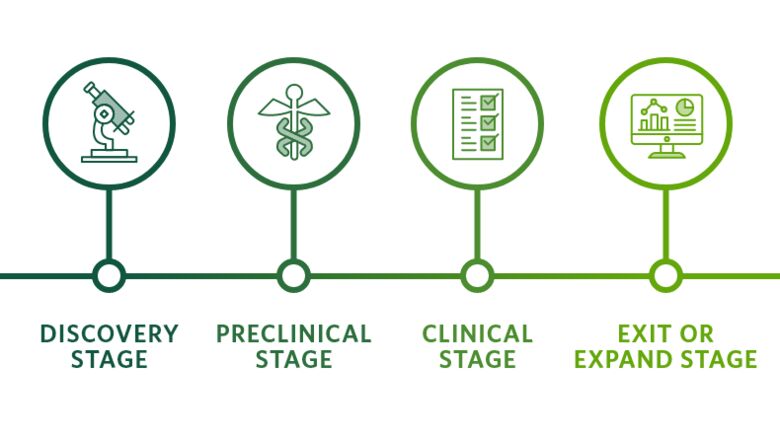
Four Stages of Life Sciences Startups
What Are Clinical Trials?
Clinical trials use human volunteers to test new drugs and potential treatments to determine whether they should be approved for use in the general population. The FDA oversees the clinical research process to ensure trials are conducted and analyzed ethically and comply with relevant regulations.
It’s common for life sciences companies to outsource the management of clinical trials to a clinical research organization (CRO). The CRO handles the day-to-day operations of the clinical trials, including:
- Site Selection
- Study Design
- Participant Recruitment
- Data Collection and Analysis
Three Phases of Clinical Trials
While moving through all three phases of clinical trials can take anywhere from two to 10 years, there are exceptions for drugs deemed critical or that have the potential to treat life-threatening illnesses with no known cure.
|
Phase 1 |
Phase 2 |
Phase 3 |
|
|
Participants |
20 to 100 volunteers, either healthy or with the condition | Up to several hundred volunteers with the condition | 300 to 3,000 volunteers with the condition |
|
Length of Trial |
Several months to a year | Six months to two years | One to four years |
|
Purpose |
Safety and dosage | Efficacy and side effects | Efficacy and monitoring for reactions |
|
Success Rate |
Roughly 70% move to next phase | Roughly 33% move to next phase | Roughly 25% move to the next phase |
Once a drug has successfully completed all three phases of clinical research, the company files a NDA to the FDA for review and market approval.
Tips for Successful Clinical Trials
During this stage, you will also be focused on determining how the drug is manufactured and packaged for consumers. Timeline issues and manufacturing readiness gaps are two pitfalls to avoid in clinical research.
Tips for success include:
- Determining a material manufacturing process that is consistent and scalable
- Planning for clinical trials early to minimize issues moving from preclinical to clinical stages
- Establishing effective communication between scientists, regulatory teams and operations
- Effectively managing the CRO, from communication and regulatory compliance to billings and organized financials

Explore Your Funding Options
Clinical trials are expensive — often requiring tens or hundreds of millions of dollars — and fundraising may be one of the biggest challenges drug development companies face, partly due to the high cost of research and development.
Life sciences startups may have an established investor group by this point, and they typically pursue Series B funding (around $15 to 25 million) or Series C funding (around $50 million or more). Venture capital funding is common, as well as investors who have a personal connection with the disease or condition the drug treats.
Initial Public Offerings
Some startups may choose to go public during this stage, as an initial public offering (IPO) provides access to public markets and can make raising money easier.
Initial preparation for an IPO necessitates significant due diligence, as the scrutiny life sciences companies face during this process extends into scientific validation and regulatory assessments. Due diligence documentation may include:
- Financial data with key performance indicator tracking
- IP portfolio documentation
- Regulatory compliance history
- Pipeline and development data
Regardless of the funding option you pursue, extensive preparation and financial diligence is vital.
Licensing Agreements
Pursuing a licensing agreement with a larger biopharmaceutical company is another option available to drug development startups. In a licensing agreement, the larger company gains rights to the intellectual property (IP) in exchange for upfront payments. Licensing deals are becoming increasingly common and are happening earlier in the life sciences lifecycle, sometimes as early as the discovery or preclinical stages.
Clinical Stage Example
A life sciences company (the Company) developing a nasal spray moved through all three clinical trial phases with success, receiving positive indications throughout the process. The Company submitted an NDA for FDA review but was denied approval due to its packaging options.
In its review, the FDA decided the applicator and dosage could be confusing to patients. The Company was told to redo its last trial, which would require millions in unexpected costs. Due to the expensive nature of drug development and low success rate, many companies decide to abandon unapproved drugs. However, the Company decided to perform another trial to prove the shelf stability of the dosage and manufacture a cap to improve the applicator.
While time consuming and costly, these product improvements provide another chance for FDA review and approval. In this situation, the Company engaged with its investors and received additional funding to pursue the follow-up phase 3 trial. As part of the fundraising efforts, the Company worked closely with its accounting firm to provide audited financial statements to the prospective investors, in addition to working closely with the due diligence team to review their income tax returns.
Your Guide Forward
Cherry Bekaert’s experienced professionals can help your life sciences company stay ahead of the curve and succeed in a rapidly changing marketplace. We serve life sciences companies through all phases of development, whether your business needs help evaluating tax structures, optimizing operations, fulfilling financial reporting and compliance requirements or capturing tax credits.
Our various teams, from Tax and Deal Advisory to Outsourced Accounting Services, provide the resources you need without the hassle of managing multiple vendors. Connect with us today to learn more about how we can help your life sciences startup succeed.
Related Insights