


Structure of the Senate
The majority party in the Senate exercises significant influence over the chamber, including selecting the majority leader, determining committee leadership and controlling the legislative agenda. A party typically needs 51 of the 100 Senate seats to control the chamber. However, in the event of a 50-50 split, the vice president may cast a tie-breaking vote, effectively granting control to the president’s party in an evenly split Senate. Senate committee membership generally reflects the chamber’s overall composition.
One of the defining features of the Senate is that it permits unlimited debate on most bills. This allows senators to use the filibuster, a procedural tactic that can prolong the debate period indefinitely, to block or delay legislation they oppose. A filibuster only ends when three-fifths of the chamber (60 or more senators) vote to end debate, a process known as invoking cloture. This procedural hurdle gives the minority party in the Senate greater influence over the legislative process.
Once debate has ended, only a simple majority is needed for most measures to pass the Senate; however, as in the House, certain situations require a two-thirds vote, such as overriding a presidential veto or proposing a constitutional amendment. There are select exceptions to the filibuster rule, including the confirmation of nominees and privileged types of legislation like reconciliation bills.
Impact on Tax Policy
The Senate Finance Committee (SFC) has jurisdiction over tax and other revenue-generating legislation, trade and tariffs, and health programs, including those under the Social Security Act. As discussed in the House page, while the Constitution requires that revenue-raising measures, including tax legislation, originate in the House, the Senate is permitted to offer or approve amendments and has occasionally utilized “shell bills” to originate their own proposals.
Public Law (P.L. 119-21), commonly known as the “One Big Beautiful Bill Act,” was enacted through the budget reconciliation process in order to take advantage of the privileged procedural status reconciliation bills enjoy in the Senate, including exemption from the filibuster. Although P.L. 119-21 originated in the House, it was the Senate’s revision that was ultimately signed into law.
119th Congress
The 119th Congress convened on January 3, 2025, beginning its two-year term. Republicans currently hold a narrow majority in the Senate with 53 seats to the Democrats’ 47, which includes two independents who caucus with the Democrats.

Current Senate leadership consists of:
| Senate Majority Leader | Sen. John Thune (R – SD) |
| Senate Minority Leader | Sen. Chuck Schumer (D – NY) |
| SFC Chair | Sen. Mike Crapo (R – ID) |
| SFC Ranking Member | Sen. Ron Wyden (D – OR) |
While Senate Republicans hold a relatively narrow majority, Majority Leader Thune has faced less turbulence from within his caucus than Speaker Mike Johnson (R-LA), who has had to govern with an exceptionally tight and shifting Republican majority in the House. Most of Thune’s hurdles have stemmed from Senate procedure, particularly the filibuster, rather than sustained intra-party conflicts. To date, three senators have departed the Senate during the 119th Congress: J.D. Vance and Marco Rubio resigned to serve in the administration, while Lindsey Graham left office following his death in July 2026.
2026 Midterms: The Senate
Senators serve six-year terms, with elections staggered so that approximately one-third of the chamber is up for election every two years. This cycle, 35 seats are up for election: 22 held by Republicans and 13 held by Democrats. Two of the Republican seats are special elections to serve the remaining two-years of terms vacated by Vance and Rubio.
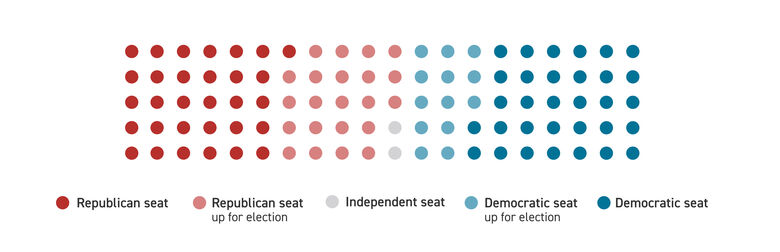
Although Senate elections are often more predictable than House contests, outcomes can still vary. Factors such as candidate quality and open seats can create uncertainty, particularly in competitive races. To date, 11 senators — seven Republicans and four Democrats — have announced they will not seek re-election, while two additional Republicans lost their primary bids.
Midterm Math
The battle for control of the Senate has become more competitive in recent months. While Republicans retain a slight edge in the fight for the majority, Democrats have opportunities to contest several key races, making control of the chamber far from certain. Historically, the president’s party tends to lose seats in midterm elections, though that pattern is generally more pronounced in the House than in the Senate. With a number of races expected to be decided by narrow margins, the path to a Senate majority remains highly fluid.
At the moment, the most competitive races are:
| Toss Up Races | AK |  |
Incumbent - Dan Sullivan (R) |
|---|---|---|---|
| IA | |
Open Seat - Previously Joni Ernst (R) | |
| ME | |
Incumbent - Susan Collins (R) | |
| MI |  |
Open Seat - Previously Gary Peters (D) | |
| OH | |
Incumbent - Jon Husted (R) | |
| TX | |
Open Seat - Previously John Cornyn (R) | |
| KS | |
Incumbent - Roger Marshall (R) | |
| Leans Democratic | NH | |
Open Seat - Previously Jeanne Shaheen (D) |
To regain control of the Senate in 2026, Democrats would need to hold all of their current seats and flip four Republican-held seats.
Back to Main Page: 2026 Midterm Elections and Implications for Tax Policy
Cherry Bekaert’s tax policy team will update this page as developments occur.