Congratulations on receiving a federally funded award. Now comes the tricky part — managing the funds properly. To avoid compliance issues and position yourself for additional funding down the road, you’ll need to make sure that your accounting system meets Federal Acquisition Regulation (FAR) compliance requirements, including being able to demonstrate that your indirect cost allocation methodology is fair and equitable and can survive government audits.
This article provides a high-level overview of the specialized accounting practices required for cost-reimbursable awards, enabling you to make informed decisions regarding the proper oversight of your accounting system.
Whether funding comes from a contract or a grant, the term "award" will be used throughout this article to encompass both funding types while discussing fundamental concepts that apply universally. In general, cost-reimbursable awards require your accounting system to comply with FAR Part 31 and 45 CFR 75, subpart E.
Cost-reimbursable Award (FAR 52.216-7) Requirements
Cost-reimbursable awards are issued by a variety of agencies of varying sizes, each with their own set of standard and unique reporting requirements. If you have a federal contract or grant containing FAR clause 52.216-7 Allowable Cost and Payment, the award is a cost-reimbursable-type funding vehicle. Within a Department of Defense (DoD) contract, this clause appears among a two- to three-page listing of FAR clauses applicable to your award.
For National Institutes of Health (NIH) and Department of Energy (DOE) grants, this clause can be less readily identifiable. A Notice of Grant Award (NOA) typically comes as a three- or four-page PDF that takes you to the specific agency’s supplemental regulations.
- NIH Award terms and conditions are embedded in a hyperlink to the NIH Grants Policy Statement, which ultimately takes you to 45 CFR 75, subpart E
- DOE Awards lead you to the eCFR website
These awards are typically subject to three levels of regulation:
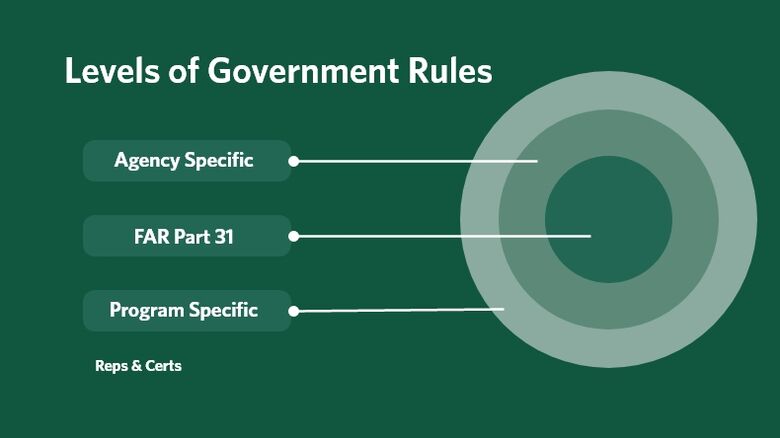
Level 1: FAR Part 31 and CAS Regulations
If you’ve received one of these awards, you’ll need to establish an acceptable accounting system and maintain an “always audit-ready” manner. Regardless of the exact type of federal award vehicle, all are subject to the accounting and administrative requirements and guidance contained in the FAR and Cost Accounting Standards (CAS).
Level 2: Funding Agency Regulations
Each government agency has the right to issue its own supplemental regulations. The DoD, NIH and DOE all have substantial supplemental regulations, which are more stringent than FAR Part 31.
Level 3: Funding Vehicle Regulations
Different program awards may carry specialized funding vehicle regulations. For example, the Small Business Innovation Research (SBIR) program requires certain ownership requirements, and the Principal Investigator (PI) is required to derive the majority of their salary from the entity receiving the award. Advanced Research Projects Agency–Energy (ARPA-E) carries cost-sharing requirements that are generally not found in SBIRs.
Note: This article only addresses “Level 1” general overview accounting and administrative requirements required by the FAR and CAS.
The following types of program awards almost always have FAR 52.216-7 embedded in the terms and conditions of their award:
- BARDA
- ARPA-E
- IDIQ
- BAA
- SBIR/STTR Phase II
- R01/U01/R21
- NIH and DOE SBIR/STTR Phase I
Understanding Cost Allowability and Compliance Requirements
The government is willing to pay all fair and reasonable costs within the constraints of their guidelines. In general, you will need to know whether a cost is allowable (as a direct or indirect expense) or unallowable. You will need to set up and maintain an acceptable accounting system. It is your responsibility to keep meticulous supporting documentation to demonstrate your accumulated project costs to a government auditor.
Why the Government Sees Your R&D Award as High Risk
When the technical specifications of the work to be done can’t be clearly defined, as is the case with most research and development (R&D) projects, the government will use a cost-reimbursable funding award vehicle. This is considered a high-risk “level of effort” contract because of the potential for cost escalation. The government will pay the contractor/grantee’s cost of performance, regardless of whether the outcome of the project is satisfactory or not.
In most businesses, the higher the risk, the greater the need for oversight. The same is true of the government. If you have a cost-reimbursable award, you need to understand which regulations apply to your situation — there are literally thousands of pages. The government does not protect your interests. You do.
Is it important to understand that with cost-type awards, the government has financial recourse back to you until all audits are done and the project is closed out. Getting this wrong can be extremely expensive.
Setting Up Your Accounting System
While some clients require more advanced systems, many government awards can be managed using low-cost, off-the-shelf solutions like QuickBooks Online. These tools meet basic accounting requirements, but compliance starts with properly setting up your chart of accounts. Unfortunately, QuickBooks Online does not offer a standard “government contracting” chart of accounts by default. To address this, we provide multiple solution levels to help you configure and maintain your system correctly.
Setting Up the Right Chart of Accounts
Your chart of accounts is a list of all the accounts used to organize your business financial activity into different groupings of assets, liabilities, income and expenses. Numbering of your accounts is strongly recommended as it creates a simple, consistent cost coding language and assists in creating a cost charging language throughout your organization. If set up correctly, your chart of accounts will streamline your ability to accumulate and report on costs and save you hours of guesswork and headaches hunting down explanations from your employees.
Your monthly government billings and annual incurred cost submission are generated from detailed, concise job cost reports. The chart of accounts forms the foundation for gathering all this information. When the government auditors arrive, your paperwork needs to clearly document the expense incurred, and the supporting documents must authenticate the transaction and approval process. Being audited is not storytelling time or a time to fumble around looking for answers!
Managing Your Expense Charge Coding and Documentation
The next step in demonstrating your acceptable accounting system to a government auditor is the ongoing ability to segregate the expenses in your general ledger as either:
- Allowable costs, which the government will reimburse you for
- Unallowable costs, which the government will not reimburse you for, as they do not derive benefit from these costs
Expense classification and coding are critical and can be complex at times. While some costs are black and white, others may fall into gray areas. In these situations, a good line of reasoning is to ask yourself:
- If it weren’t for this project, would we have incurred this expense?
- Which projects benefit from incurring this expense?
| Allowable Costs | Unallowable Costs |
|
Direct Costs: Expenditures for goods or services only benefitting one government (or commercial) project, such as:
|
|
|
Indirect Costs: Expenditures for goods or services benefitting multiple projects, such as:
|
In general, costs that only benefit a specific project are direct expenses, and costs that benefit “the business” are indirect expenses. Our experience shows that many new award winners dramatically underestimate their indirect costs. More importantly, they fail to understand that the government prefers to do business with companies that continue to advance their resources and solutions.

Recording Labor Costs and Maintaining Timesheets
Labor costs are usually the largest expense for R&D projects. As such, the government requires every company employee whose costs are directly or indirectly billed to them to maintain a timesheet.
These timesheets must include all the active projects that your employees are working on, both government and commercial, as well as charge categories to account for indirect labor, such as vacation, holidays, sick and administrative time.
It is also a FAR requirement for your company to have the following timekeeping policy:
- Timesheets must be prepared in ink
- Employees must record all time spent (even if more than 40 hours/week)
- Employees must sign off on all timesheets and must get their supervisor’s approval
- Any corrections must be handled as follows:
- Do not erase anything
- Draw a line through any errors
- Write in the correct information in ink, initial and date the correction
In practice, your time-tracking system can be either manual (paper) or electronic. The government doesn’t make blanket approvals for commercially available electronic time-keeping systems. However, to be considered acceptable by a government auditor, an electronic system must provide a date-stamped audit log for all data entry, including changes and approvals, which effectively creates a forensic trail.
The government expects transparency and accuracy in reporting labor costs, ensuring they reflect actual time incurred without manipulation.
When awardees begin their business operations, we typically advise them to simply pay themselves an hourly rate for all their recorded time. Paying salaries introduces the possibility of uncompensated overtime, which can complicate matters.
Job Cost Reporting
All expenses must be accumulated in your general ledger (with the assistance of a good chart of accounts) and must reconcile with your job cost reports, a form of subsidiary (or additional) ledger. Job cost reports are critical for internal decision making and external reporting requirements. They will also:
- Act as support for billing the government for incremental monthly project costs accumulated
- Be used to report cumulative spending by budget category to your customers, which they use to monitor technical progress achieved on the goals of the project
- Provide a signal to management when to wrap up a project to prevent overspending
Indirect Cost Reporting
As mentioned above, indirect costs come from expenses related to your overall business, which aren’t incrementally caused by specific projects. They include electricity, rent, accounting and telephone expenses. These costs indirectly benefit all your projects and need to be proportionally allocated, charged and “paid for” by all your projects — government and commercial alike. If they all benefit from the rent, they should all pay for it.
All projects pay for these costs via an indirect cost recovery rate. Your indirect cost rate recovery methodology is what you believe to be the most fair and equitable way to proportionally charge these costs to all your customers on an ongoing basis. Once per year, the government requires you to prepare an incurred cost submission or “true up” report, which reconciles monthly indirect cost rate charges with actual indirect expenses.
Just because a government agency creates a cost proposal template in a certain terminology format does not mean you must adhere to their format! You need to determine the best methodology for recovering your indirect costs — especially if you are doing business with multiple agencies. We are typically advocates for keeping it as simple as possible.
Different government agencies will refer to indirect costs using slightly different terminology: fringe, fringe and F&A rates, overhead rates, overhead and G&A rates. These terms and their prescribed use in cost proposal forms are nothing more than methodology nomenclature common to that agency.
Underestimating Indirect Cost Rates
The indirect cost recovery rate that you propose to the government should represent the indirect costs that you need to fairly reimburse yourself for indirect expenses — that is your right. However, many companies underestimate this rate when they propose projects and do not charge the government anything resembling their actual rates because the competition for government funding is intense.
While undercharging the government for indirect expenses is legal, it is expensive as it leads to guaranteed project cost losses that need to be paid for somehow, and it may or may not be a good strategic idea. The government will certainly not stop you from giving them a good deal.
Conversely, if you overbill, they will require swift repayment of the overbilling. If you do not have equity backing or an extremely profitable commercial revenue stream, undercharging for your actual indirect costs can be a swift path to financial ruin.
Annual Incurred Cost Submissions
No matter your reason for requesting a low indirect rate, you are never excused from calculating your actual indirect rates monthly or properly reporting them to demonstrate that you’re under-billing your government customer. Each government agency has a slightly different approach to indirect cost rate negotiations. However, the annual incurred cost submission is one of the key historical reports used to negotiate your final indirect cost rate.
The presence of FAR 52.216-7 in the terms and conditions of your contract or notice of grant award means you have a cost-reimbursable award. When you initially propose the project, you request an indirect cost rate to provisionally (temporarily) invoice the government monthly. The annual incurred cost submission is effectively a true-up report you must prepare, which shows how you calculate your final, actual indirect cost rate. Once submitted, you are required to reimburse the government for any indirect costs overbilled.
Complying With Government Audits
Poor audit outcomes can result in delays in paying invoices, termination and repatriation of funding and, in the worst case, criminal and civil indictments.
Finding the Right CPA for Your FAR Part 31 Accounting
Government contract accounting is a rare specialty and requires a deep and current understanding of FAR Part 31, each agency’s supplemental regulations and funding vehicle regulations.
Federal grants and contracts come with government audits. Make sure your CPA specializes in government funding award accounting, knows the federal and agency regulations, and can help you stay compliant. This is imperative to your funding, innovation and business.
How To Tell if Your Accountant Is Qualified To Handle Your Needs
While knowledge of GAAP is the baseline for applying the specialized rules of FAR Part 31, it is only the beginning. There are many nuances to FAR accounting that can only be learned through experience. To see if the individual overseeing your financial relationship with the federal government is qualified to help you with your government contract and grant accounting, ask them how many indirect cost rates they’ve negotiated!
Your Guide Forward
Receiving a government funding award can be a real game-changer. But there are strings attached in the form of FAR and CAS reporting and accounting requirements.
There are also requirements unique to different government agencies and even different types of funding vehicles. Audit findings, penalties, future funding, and even the original award itself depend on your accounting practices.
Collaborate with Cherry Bekaert’s Government Contractor Consulting team to navigate complex compliance requirements and maximize the value of your awards. With a proven track record in government contracts and grants, our professionals provide the guidance you need to avoid costly surprises and stay audit-ready.