


The high failure rate of biopharma companies makes it crucial to develop a strategic commercialization strategy in the final phase of the startup lifecycle, as the focus shifts from research and development (R&D) to commercialization.
Roughly 70% to 85% of life sciences companies never reach this stage, according to Life Science Leader. Getting your product this far is half the battle; you don’t want to risk mismanaging manufacturing and distribution — or the exit — as your drug prepares to enter the market.
Key Priorities of the Life Science Startup Exit Stage
- Engaging investment banks, accountants and legal firms
- Finalizing financial, legal and R&D due diligence
- Hiring key executives with commercialization or public company experience
- Deploying growth capital to expand marketing and sales operations
At this point in the life sciences journey, your drug has been approved by the Food and Drug Administration (FDA), and the company may have already gone through substantial private investment or an initial public offering (IPO) during the clinical or preclinical phases.
This article covers key elements and strategies for success in the expand or exit stage. You can read more about each phase of a life sciences company in our previous article.
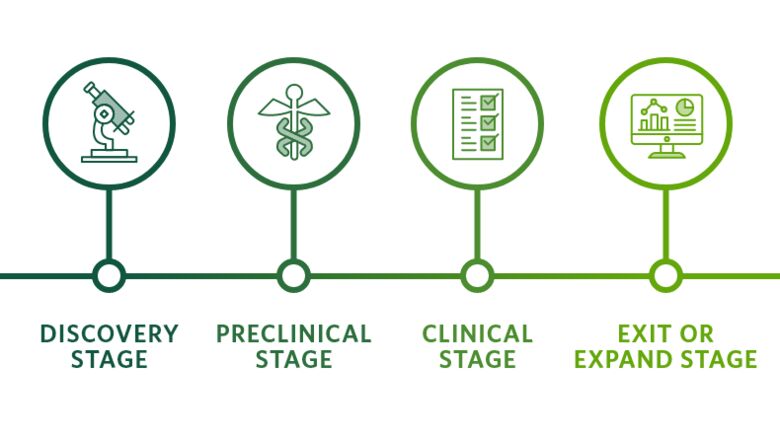
Explore Your Exit Options
Given the relatively high failure rates in the biopharma industry, a well-executed exit strategy is essential, as investors rely on successful exits to recoup their investments. Additionally, a successful exit can provide access to more funds that fuel further research and innovation. It’s important to consider the best option for your startup’s needs and ensure it aligns with the company’s vision and goals.
Initial Public Offerings
An IPO involves offering shares of your company to the public, which allows you to gain access to a broad pool of investors. IPOs are common exit strategies, and you may choose to go public during the clinical phase to raise capital or explore this option later, once the drug has received approval and is ready to go to market.
While an IPO can provide numerous benefits to life sciences companies, including increased liquidity, it also increases regulatory scrutiny and exposes the business to the whims of the stock market. Preparing for an IPO requires due diligence documentation, such as:
- Financial data with key performance indicator tracking
- IP portfolio documentation
- Regulatory compliance history
- Pipeline and development data
Acquisitions
Being acquired by a larger entity is another popular exit option and provides startups access to the resources and infrastructure of an established company. Because life sciences companies typically operate in the pre-revenue phase for years, it is often beneficial for them to merge with a bigger company with existing sales and marketing networks and manufacturing capabilities.
However, an acquisition may also result in restructuring or changes in leadership that may be disruptive to employees and existing workflows. You also risk the acquiring company not fully understanding the startup’s product or technology. This option also requires significant planning and due diligence, including:
- Business valuation services
- Sell-side diligence representation
- Tax due diligence
Licensing Agreements
Pursuing a licensing agreement with a larger biopharmaceutical company is another exit option gaining traction in the life sciences industry. In a licensing agreement, the larger company gains rights to the intellectual property (IP) in exchange for upfront payments, future milestone payments and ongoing royalty on sales. Licensing deals are becoming increasingly common and are happening earlier in the life sciences lifecycle, sometimes as early as the discovery or preclinical stages.
Elevate Your Operations
If the company doesn’t want to go through another exit (or has previously had an IPO or exit event), this stage will likely bring strategic changes in management. Since the company is no longer focused on drug research and development, its priorities undergo a significant shift to operations and generating revenue. You may need to find new talent with experience in:
- Manufacturing
- Accounting and finance
- Insurance billings, reimbursements and distribution agreements
- Selling the product through hospital systems and other avenues
- Handling procurement
Streamlining operations will also make the business more attractive to investors or potential acquirers.
Technology Upgrades
Implementing or upgrading an enterprise resource planning (ERP) system can significantly enhance operations, as it aligns the core departments in a company and helps integrate disparate systems and workflows. The right ERP can also enhance data visibility and accuracy, increase efficiency and serve as a launching pad for your business to leverage artificial intelligence (AI) and data integration in day-to-day operations.
Modernize the Finance Function
Finance and accounting operations will take on new importance during the expand or exit phase now that the company is generating profit. Streamlining finance processes and upgrading workflows becomes an important component of elevating your operations, as the business begins to handle tasks like income tax planning and maximizing tax credits. When optimizing finance and accounting, consider:
- Financial planning and analysis (FP&A) to improve decision-making and profitability
- General accounting to handle routine transactions, reporting, monthly close and more
- Technical accounting to support complex tasks, like audit readiness and adopting new standards
- Infrastructure setup of financial systems and processes
- ERP and automation tools to integrate data and streamline workflows
Working with an outsourced accounting team may be beneficial at this stage, as the business structure and finance function grow more complex. Third-party professionals can also help maximize the tax credits the company has generated, such as New Markets Tax Credits (NMTC).
Your Guide Forward
The expand or exit stage is an exciting time in the lifecycle of a life sciences startup. After years of development and clinical trials, the drug is finally approved for consumers. This success brings a new level of complexity to operations and the shift from being a pre-revenue business to a revenue-generating one may pose unexpected challenges.
Cherry Bekaert’s Assurance Services and CFO Advisory teams provide a range of services to support your business during expansion or an exit. We can help your life sciences company stay ahead of the curve and succeed in a rapidly changing marketplace, whether your business needs help evaluating tax structures, optimizing operations, fulfilling financial reporting and compliance requirements, or capturing tax credits.
Related Insights