The Internal Revenue Code (IRC) Section 179D Energy Efficient Commercial Buildings (Section 179D) tax deduction provides financial incentives for building owners and designers (i.e., architects, engineers, design-build contractors) to implement energy-efficient designs in commercial buildings.
When it comes to reporting this deduction, it is crucial to understand that, for deductions relating to prior years, designers cannot use Form 3115 "Application for Change in Accounting Method”. Instead, the deductions must be reported on an amended tax return or using Form 7205 for buildings placed in service in 2022 and later.
Read on to learn more about this Internal Revenue Service (IRS) tax form and how it can be used correctly.
What Is Form 3115?
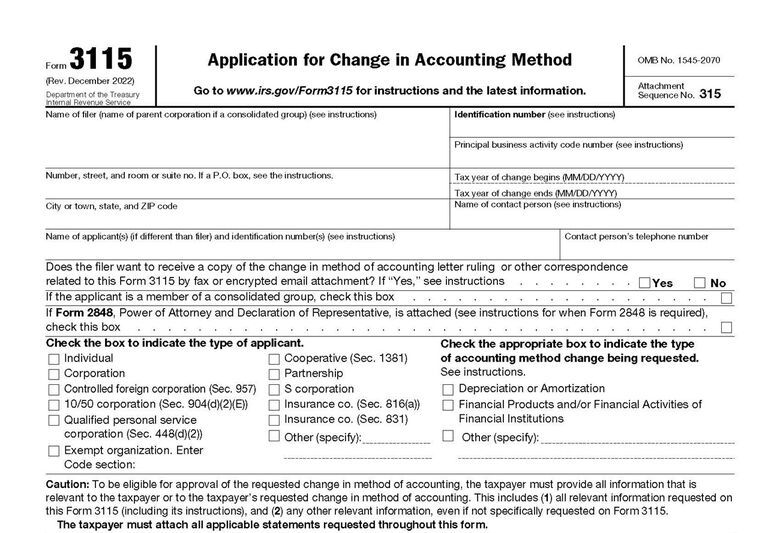
Form 3115 is used to request a change in accounting method, including changes in accounting principles, accounting for income or expense and other adjustments related to the timing of income and expenses.
To complete this form, the filer will need to provide:
- Name
- Applicant Type
- Identification Number
- Address
- Tax Year(s) That Need To Be Updated
- Contact Information
- Type of Accounting Change
The filer will also need to include the business’s balance sheets and income statement along with a detailed explanation of the previous accounting method used and the new one being selected.
Accounting Method Changes
As mentioned above, this form is designed to help taxpayers align their accounting methods with tax regulations and is typically used for comprehensive changes or correcting improper accounting practices. For example, filing this form allows business owners to choose from accrual accounting, cash-basis accounting or modified cash-basis accounting.
To submit this form for this purpose, it will need to be completed, especially Parts I, II and IV, along with Section 481(a) where you will calculate the cumulative adjustments. You also need to attach an explanation of the current accounting method, the new method you want to use and the reason why you want to change. Then the completed form will be submitted with your tax return. A copy should also be sent to the IRS national office after the first day of the year in which the new method is used.
Contact a tax professional to learn more about filing Form 3115 for an accounting method change.

Cost Segregation Study Deductions
Filers can additionally use Form 3115 after a cost segregation study to shorten the assets lives and claim bonus depreciation. Submitting this form to the IRS allows building owners to change their depreciation method for the assets in question.
To use Form 3115 for a cost segregation study, you will still need to complete the form like you would for an accounting method change. However, the study will determine the depreciation schedules and the Section 481(a) adjustment.
[H3] Section 179D Energy Efficient Commercial Tax Deductions
IRC Section 179D allows for a tax deduction for energy-efficient commercial building property. Designers can benefit from this tax deduction when they are responsible for the design of tax-exempt buildings that achieve energy savings exceeding specific standards. The tax deduction can be significant, up to $5+ per square foot of the building, following the Inflation Reduction Act, depending on the level of energy savings achieved.
While not a proper procedure for designers to claim the Section 179D tax deduction, building owners claim the Section 179D tax deduction this way. Reach out to a tax professional before using this method to ensure compliance with IRS rules.
For architects who need to adjust their taxes related to Section 179D deductions, the following steps are recommended instead:
- Accurate Certification: Ensure that all energy savings certifications meet the IRS requirements and are thoroughly documented.
- Amended Returns: If a tax deduction was missed in a previous tax year, file an amended return (Form 1040X for individuals or Form 7205 for business entities) to claim the deduction correctly.
- Consult Cherry Bekaert: Work with a tax professional who has experience with energy efficiency deductions and tax law to ensure compliance and optimize the tax benefits.
Why Form 3115 Is Not Suitable for Designers With Section 179D Adjustments
Cannon Corp. v. Commissioner
In Cannon Corp. v. Comm’r of Internal Revenue, February 18, 2025, the court determined that because a design firm did not own the property, and could not take annual depreciation deductions on it, any IRC Section 179D deduction was not an acceleration of depreciation that could be reported on a Form 3115. Instead, it was a one-time allocated deduction that would permanently reduce the design firm’s taxable income, which should have been reported on an amended income tax return.
The Court of Appeals upheld the U.S. Tax Court’s decision denying Cannon Corporation's attempt to retroactively claim Section 179D tax deductions on its 2011 tax return. Cannon aimed to report deductions for 2007 – 2010 as a change in accounting method under Revenue Procedure 2011-14. However, the Internal Revenue Service (IRS) clarified in Revenue Procedure 2012-39 that these tax deductions could not be claimed this way.
The court ruled that these deductions did not qualify for adjustment under Section 481(a) as they did not represent a change in accounting method. Cannon's equitable claims, such as equitable estoppel and equitable recoupment, were rejected for lacking merit. The court found no misrepresentations by the Commissioner and concluded that Revenue Procedure 2011-14 did not require Cannon to report the deductions as claimed. Thus, the appeal was denied, affirming the 2011 tax deficiency determination.
Recommendations for Using Form 3115
If you plan on using Form 3115 for an accounting method change, after a cost segregation study or to claim the Section 179D deduction as a building owner (not as a designer), consider doing the following:
- Make sure to fill out all the relevant sections of the form.
- Submit the form after the first day of the year in which the change takes place.
- If you have the form prepared for you professionally, make sure they provide their Preparer Tax Identification Number and sign the form.
- Do not forget to include the supporting documentation.
Your Guide Forward
While the IRC Section 179D deduction offers substantial tax benefits for architects, using Form 3115 to adjust taxes for this deduction is not advisable. Cherry Bekaert’s team of CPAs, engineers and attorneys can help you understand the correct processes for claiming and adjusting these deductions to help you maximize benefits without encountering unnecessary risks or complications.
Related Insights