An Industry Snapshot From the Middle Market CFO Survey
Real estate and construction CFOs are pursuing growth aggressively, but many are doing so with finance operating models that were designed for fewer entities, simpler ownership structures and slower capital cycles.
The Middle Market CFO Survey shows a sector that is confident about expansion, yet constrained by disconnected systems, manual workarounds and fragile forecasting processes. As companies scale, these gaps can slow finance teams down by introducing risk in budgeting, cash visibility, lender confidence and audit readiness. And like finance leaders across all industries, real estate and construction CFOs are being pushed to perform beyond their traditional responsibilities to serve as drivers of strategic decision-making — a task that is increasingly difficult to achieve with fragmented data and outdated models.
Both the real estate and construction industries grapple with unique financial reporting and budgeting complexities, as companies often contain multiple entities with varying ownership levels. This, along with regulatory changes and competitive pressures, makes modernizing the finance function critical for sustained growth.
Cherry Bekaert surveyed CFOs and senior finance executives at U.S. enterprises with revenue between $5 million and $250 million across various industries, including real estate and construction, to better understand the current and future trajectory of their modernization efforts. The full report is available at cbh.com/cfosurvey.
Growth Ambition Is Outpacing Finance Readiness
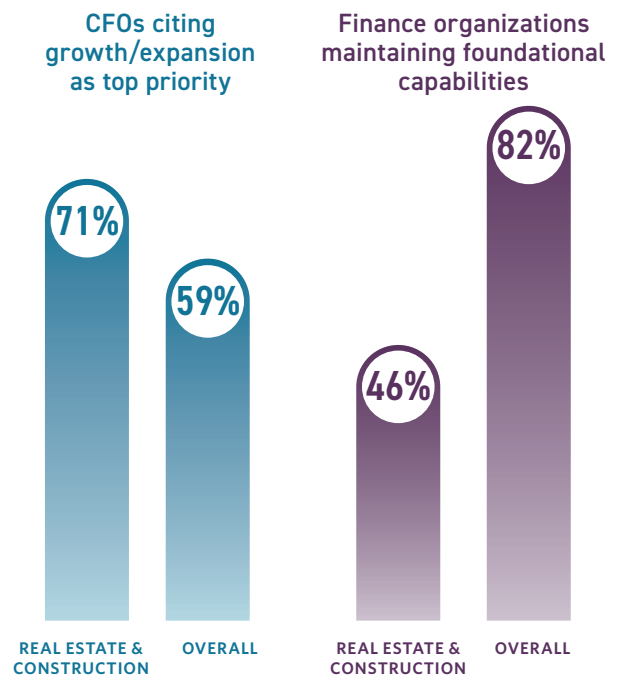
Nearly three quarters (71%) of real estate and construction CFOs cited company growth or expansion as finance’s top strategic priority, significantly higher than the overall survey population. Digital transformation followed closely behind with 61% viewing tech upgrades as a main goal. While 82% of respondents reported that modernization initiatives are underway, nearly half said their finance organizations are still maintaining foundational capabilities rather than transforming them.
That combination — aggressive growth paired with early‑stage maturity — creates a widening gap between ambition and execution, which could undermine scalability. CFOs recognize the need to modernize, but many are attempting to do so with operating models that were never designed for multi-entity complexity, project-based revenue or capital-intensive growth.
Growth Is the Priority, but Finance Foundations Lag
WHAT THIS MEANS FOR CFOS
Growth rarely fails because of strategy. It fails when finance foundations are unable to scale in the face of entity complexity, capital intensity and reporting expectations.
Modern Systems, Manual Reality
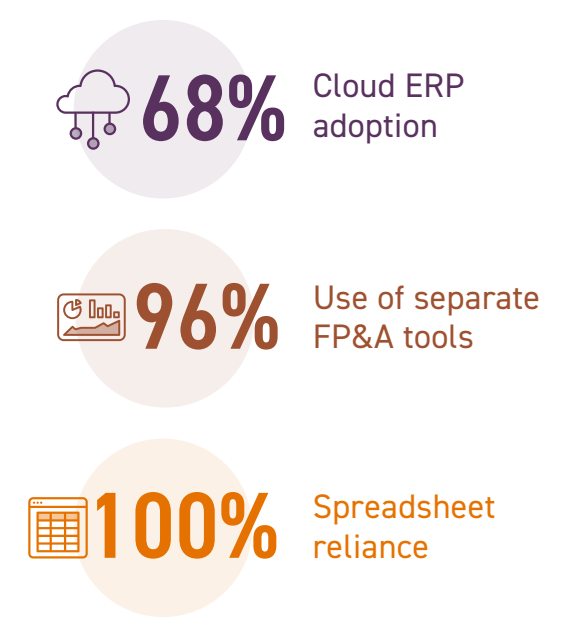
While 68% of real estate and construction CFOs report using cloud ERP platforms, spreadsheet reliance for core financial tasks remains universal. CFOs consistently point to data quality, timeliness and system integration as top internal challenges, which suggests that having modern platforms in place has not resolved the underlying connectivity gaps between systems.
When finance teams are still reconciling between tools rather than analyzing output, issues often center around a lack of connectivity across the revenue-to-cash lifecycle, rather than the specific technology teams own.
Modern Platforms, Manual Workarounds
Why Budgeting and Forecasting Break First
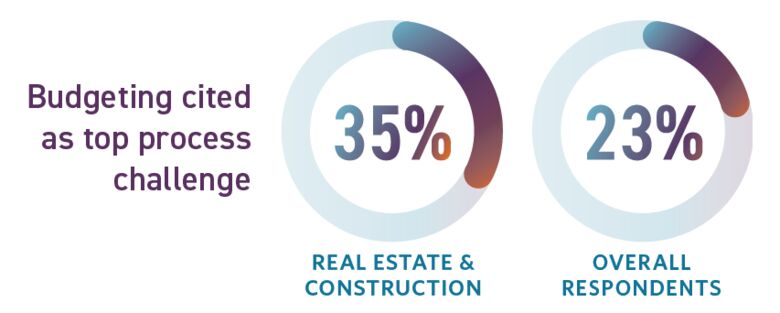
Budgeting was cited as the top process pain point for real estate and construction CFOs (35%, compared to 23% overall). Cost control, planning and operational performance monitoring are all being hampered by the same issues CFOs identified as their top challenges: lack of integration between systems, data accuracy gaps and time‑consuming manual processes.
Budgeting Complexity Stands Out in Real Estate & Construction
At the same time, CFOs expect finance teams to spend more time on analytics, scenario planning and insight generation in the coming years. That shift will be difficult to achieve when current forecasts are still built on high-level assumptions rather than the operational drivers that actually move cash, such as backlog conversion, change orders, retainage, lease-up timing or cost of capital.
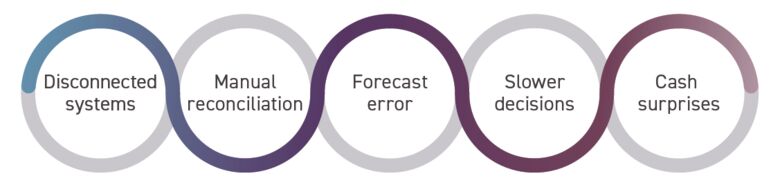
This disconnect results in forecast error, cash surprises and slower decision-making at precisely the moment speed and confidence matter most.
How Disconnected Data Undermines Forecast Confidence
External Pressure Raises the Stakes
Real estate and construction CFOs identified regulatory change, competitive pressure and inflation/interest rates as their top external concerns. Recent federal and state tax developments, coupled with increased lender and investor scrutiny, have made tax configuration, documentation, and audit readiness front-loaded finance decisions rather than backend cleanup exercises.
As organizations scale, often across multiple entities and ownership structures, finance leaders are being asked to produce faster, more defensible reporting while managing growing complexity in tax, billing and revenue recognition. In this environment, weak controls or unclear ownership create inefficiencies and present new risks.
Who Is Raising the Bar on Finance Reporting?

Talent Constraints Limit the Pace of Change
Recruitment, retention and resistance to change were the top talent challenges reported by real estate and construction CFOs. There remains intense competition for experienced controllers, project accountants, FP&A professionals and tax talent, putting upward pressure on costs and creating operational strain. Validity for this point is demonstrated with anecdotal evidence; CFOs are being given greater control over system selection and are finally being allowed to influence operational system choices, something that was rarely the case in the past.
These constraints place a natural ceiling on how quickly finance teams can modernize through hiring alone. As a result, many CFOs are rethinking operating models — clarifying ownership, standardizing processes and selectively supplementing internal teams — to stabilize performance while modernization efforts take hold.
Talent Constraints vs. Finance Expectations
| Talent Constraints | Finance Expectations |
| Hiring difficulty | Faster close |
| Retention risk | More reliable forecasts |
| Change fatigue | Better insight for decision-making |
Where the Pressure Shows Up First
While the survey does not break results out by subsegment, CFO conversations consistently point to where disconnected systems and manual processes create the most strain.
Where Disconnected Finance Creates the Most Friction
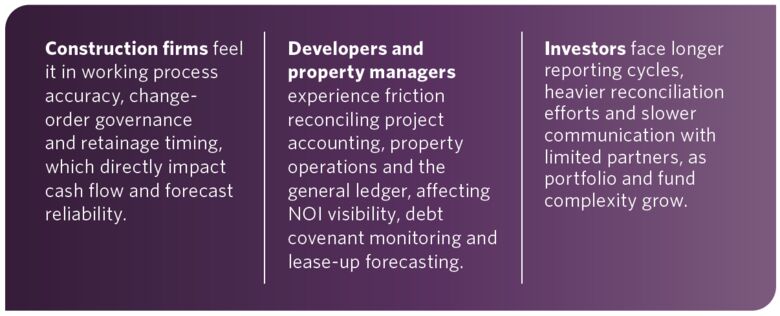
Across segments, the pattern is consistent: fragmented data and siloed, manual processes result in finance teams spending too much time assembling numbers and not enough time governing them.
What CFOs Are Prioritizing First
Typically, CFOs who are making progress are focusing on a small number of foundational moves that compound over time, rather than attempting to overhaul entire systems. Leaders can improve their modernization momentum by:
1. Pursuing targeted integrations
Integrating operations with accounting to streamline financial management and reporting is often at the top of CFOs’ to-do lists. Prioritizing targeted integrations and standardized handoffs reduces reconciliation, improves data confidence, and shortens close and reporting cycles. Integration can be viewed as a control that further enhances data accuracy and availability.
2. Rebuilding forecasts to fuel investor lending
Shifting from generic top-down models to forecasts anchored in operational drivers improves scenario planning and decision readiness. Home builders are increasingly rebuilding forecasts around previously known costs to leverage for investor lending.
3. Designing regulations and compliance into planning
Incorporating local regulation considerations earlier in bids, leases and billing helps avoid surprises and strengthens audit and lender readiness as organizations scale. Waiting to address regulatory compliance and tax until after contracts are signed, or leases are executed, can undermine audit readiness and hinder leaders’ view of cash flow under changing policies.
4. Clarifying ownership in a constrained talent market
Assigning clear responsibility for core finance outputs and selectively augmenting teams where needed helps stabilize cadence and sustain change. This may look like implementing evidenceready controls or co-sourcing or outsourcing certain functions. Notably, assigning ownership over specific functions can also guard against knowledge loss when talent leaves, provided a knowledge transfer plan is developed in tandem.
Rather than blindly focusing on driving the perfect transformation initiative, these steps aim to restore confidence in the numbers that guide vital growth decisions. When that happens, CFOs are better prepared for the evolving demands of their roles, and modernization can more seamlessly support decision-making and expansion.
How CFOs Measure Progress

Looking Ahead
Real estate and construction CFOs remain financially prepared to pursue growth opportunities, even amid regulatory change, capital market volatility and talent pressure. The survey makes clear, however, that growth without finance readiness introduces risk that compounds quickly at scale.
By strengthening the foundations — connecting systems, aligning forecasts to operations and embedding control into everyday workflows — finance leaders can shift from reacting to issues after the fact to guiding decisions in real time.
In a sector defined by long cycles and large commitments, that shift is what turns modernization into a durable competitive advantage.
“Real estate and construction CFOs are being asked to support aggressive growth while operating in increasingly complex environments. This survey makes clear that modernization isn’t about adopting more tools — it’s about reconnecting data, improving forecast confidence and giving leaders the visibility they need to make decisions at scale. It reinforces that finance readiness, not strategy, is often the limiting factor to sustainable growth. As organizations scale across more entities, projects, and stakeholders, disconnected systems and manual processes introduce risk that compounds quickly.”
Why Choose Cherry Bekaert for Finance Modernization
We understand the middle market because it has been our focus from the start. We have successfully guided clients through various stages of growth, allowing us to understand the evolving landscape and the critical factors that drive success.
At Cherry Bekaert, we empower companies to modernize their finance function with a people-first, performance-driven approach. By aligning strategy, technology and talent, we help CFOs eliminate inefficiencies, unlock real-time insights, and build scalable processes that drive accuracy, agility and growth.
Our tailored roadmap delivers quick wins in the first 30/60/90 days while laying the foundation for long-term transformation — turning finance into a catalyst for enterprise-wide results.
Let us be your trusted advisor, cbh.com/modernfinance.