The real estate and construction industry is poised for continued expansion, yet remains constrained by disconnected systems and manual workarounds that pose risks to already tightening margins, as 40% of residential builders report cutting prices to adjust to a cooling market.
Cherry Bekaert's 2025 Middle Market CFO Survey found that 99% of CFOs plan to modernize their finance operations in the next twelve months, with 59% supporting company expansion or growth and 52% involved in digital transformation efforts. Yet 26% still rely on manual processes for core activities like month-end close, audit preparation and budgeting.
For production builders juggling lot-level job costing across multiple communities, that gap between modernization ambition and operational reality carries real financial consequences. To address these issues, finance leaders are rethinking their tech stacks, with enterprise resource planning (ERP) systems offering a path to streamlined workflows that support growth, rather than hinder it.
Construction Companies: CFO Challenges
As a residential construction CFO, you are all too aware of the margin erosion caused by fragmented operations and siloed systems that are common in the industry. The nature of juggling multiple projects and numerous vendors lends itself to fragmentation, and construction professionals often find themselves job costing in spreadsheets, manually tracking vendor contracts and scheduling in standalone tools.
Unfortunately, accounting is left to manually reconcile the discrepancies at month-end, and CFOs face a cascade of obstacles, including:
- Delayed financial closings
- Inaccurate cost-to-complete estimates and lot-level profitability
- Change order budget overruns
- Revenue recognition complexity
- Increased pressure to improve reporting speed, forecast accuracy and margin protection
As the residential construction industry faces tariff-driven material cost increases — adding an estimated $10,900 per new home — a deepening skilled labor shortage and compressed margins from builder price concessions, CFOs can no longer afford the operational drag of disconnected technology. The right construction management ERP can drive finance modernization and integrate disparate systems into one central platform.
Using ERPs To Transform the Finance Function
A construction ERP brings core business functions — finance, project management, resource planning, field operations and procurement — together into one unified platform. This allows for greater visibility into operations and strengthens project execution, in addition to numerous CFO-relevant benefits, including enhanced cash flow management and improved stakeholder confidence. Due to the complexity of the industry, generic ERP tools tend to fall short for production builders because they lack the ability to track a project through numerous phases and may use a one-size-fits-all approach that does not address the demands of the construction process.
Benefits of ERP in the Construction Industry
A construction-specific solution built within an ERP platform, like HomeBuilder by Suite Engine, provides industry-specific features, such as lot management and buyer portals, that will actually drive operational transformation.
Built within Microsoft Dynamics 365 Business Central, HomeBuilder is purpose-designed for production builders constructing single-family homes, townhomes and multi-residential developments. HomeBuilder is fully integrated within Business Central, extending the ERP’s core functionality with construction-specific features.
With HomeBuilder’s integrated, single platform:
- Lot-level job costing flows directly into the general ledger
- Construction schedules connect to purchase orders and vendor contracts
- Buyer selections update budgets in place
- Change orders automatically adjust committed costs
- Revenue recognition that follows percentage-of-completion rules without manual calculations
Production Builder’s Data Flow
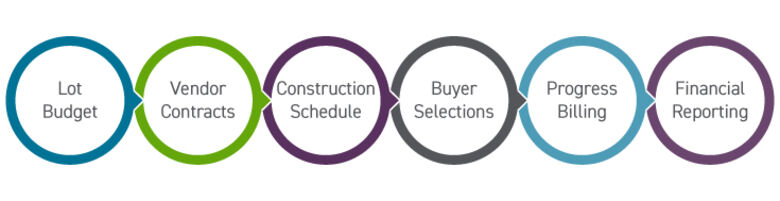
Without these capabilities, construction companies may attempt to work around a system’s limitations and bolt on standalone construction job costing software or disconnected vendor management tools. If a chosen ERP system is not tailored to the unique needs of production builders, CFOs will continue to face the fragmentation problem they thought implementing new technology would solve.
Production builders manage five, 10, or 20+ active communities and need consolidated financial visibility across all of them, not community-by-community spreadsheet roll-ups.
HomeBuilder Benefits to CFOs
HomeBuilder enables increased visibility into costs at every level, including models, individual lots and entire communities. This allows CFOs to have greater control over the budget by tracking potential overruns before they become issues, providing better estimates for future projects and maintaining detailed cost histories.
Automated progress billing and deposit management help finance leaders streamline manual processes, while vendor contract controls with retainage and holdback processing allow for more effective cash flow management.

Defining Your ERP Strategy
ERP selection, implementation and deployment is a time-consuming, and often complex, process. Without a clearly defined ERP strategy that addresses the unique needs and challenges of your construction company, the result may be ERP failure rather than finance transformation.
A lack of stakeholder buy-in, ineffective integration planning, failure to anticipate customization requirements and a misalignment with the business growth model are all common reasons for ERP deployment failure. Develop an ERP strategy playbook to create a clear roadmap that outlines the critical elements of the process:
- The customized solutions and integration plan the ERP offers. Make sure these solutions address the organization’s unique needs and the integration plan provides a smooth transition.
- Your risk assessment and mitigation strategies to avoid potential risks with data migration and other issues.
- The deployment timeline, which encompasses all stages, including vendor selection, employee training and go-live.
A well-defined ERP strategy will proactively address common obstacles and facilitate a smoother transition and better user adoption. Because HomeBuilder is built within Dynamics 365 Business Central, rather than operating as a standalone platform, builders who already use Business Central or are evaluating Microsoft's ERP ecosystem can adopt construction-specific functionality without replacing their core system.
5 Questions Production Builder CFOs Should Ask Before Selecting Technology
ERP selection is daunting. There are numerous options, and you don’t want to risk being stuck with an expensive platform that doesn’t fully address the needs of your construction firm. Before selecting a software, ask these questions:
- Can the system track lot-level job costs by phase, model and cost code, with budget-to-actual visibility that flows directly into financial reporting?
- Does the platform handle buyer selections and change orders in a way that automatically updates the lot budget, or does your team reenter those figures manually?
- Can you report on multi-community profitability, construction progress and cash position from a single system, or are you consolidating data from multiple sources?
- Is the solution purpose-built for residential construction workflows, or is it a generic project management tool with customizations?
- What does the implementation and adoption path look like for your existing team, and does the system scale as you add communities?
Guiding Production Builder CFOs Forward
Real estate and construction CFOs stand at a pivotal intersection between sustained growth and outdated, manual processes that hinder progress. Cherry Bekaert’s CFO Advisory Services practice holds deep knowledge of the challenges mid-market CFOs face, as well as the solutions they need to drive transformation. Combined with the capabilities of our Digital Advisory practice, our advisors are equipped to help your company build digitally driven operating environments.
From ERP strategy and vendor evaluation through implementation and adoption, Cherry Bekaert provides end-to-end advisory support for builders modernizing their technology stack. We understand both the financial strategy and technological execution needed to facilitate finance modernization and are ready to guide you forward. Connect with a Cherry Bekaert advisor to learn more about our digital solutions.