


Healthcare organizations strive to provide top-tier patient care while grappling with complex accounts receivable and revenue cycle management (RCM) challenges. Unpredictable payment schedules create financial instability, complicating budget planning and cash flow management. This can lead to difficulties with bill payments, growth investments and maintaining patient care.
As healthcare organizations navigate this intricate landscape, the need for innovative technological solutions becomes increasingly evident. Advanced data solutions enable providers to overcome these challenges and achieve sustainable growth.
Healthcare Billing Cycle Complexities
The healthcare billing cycle is inherently intricate. A typical patient's journey begins with a doctor's visit, followed by claim submission. This claim can follow multiple pathways with distinct processes and timelines, including private insurance, Medicare, Medicaid or private pay. Claims often pass through clearinghouses, where delays can occur. Payments may be made within the same month as the service date or be deferred due to factors such as:
- Unpredictable Reimbursement Patterns: Insurance companies and government payers can take longer to reimburse claims. Prior authorization and claim denials are increasingly frequent and time-consuming to resolve.
- High Denial Rates: Coding errors, missing documentation and eligibility issues increase denial rates. Denial management requires significant manual effort that slows cash flow.
- Volume Uncertainty: High-deductible health plans transfer more costs onto patients. Collecting payments from patients is more difficult and slower than from insurers, leading to an increase in bad debt.
- Regulatory Changes: A lack of skilled billing and revenue cycle staff and reliance on outdated systems hinders timely claim submission, follow-up and collections.
- Insufficient Use of Analytics: Many accounts receivable sit in 90+ or 120+ day buckets, reducing liquidity. This complicates identifying collectable claims versus those likely to be write-offs.
“This uncertainty complicates healthcare financial planning, demanding the use of precise technologies to streamline the revenue cycle process. Forward-looking, it’s imperative for healthcare providers to have insight from their data to model future revenue, thus the importance of leveraging a Data Lakehouse architecture.”
How Databricks Integrates Data Lakes and Data Warehouses
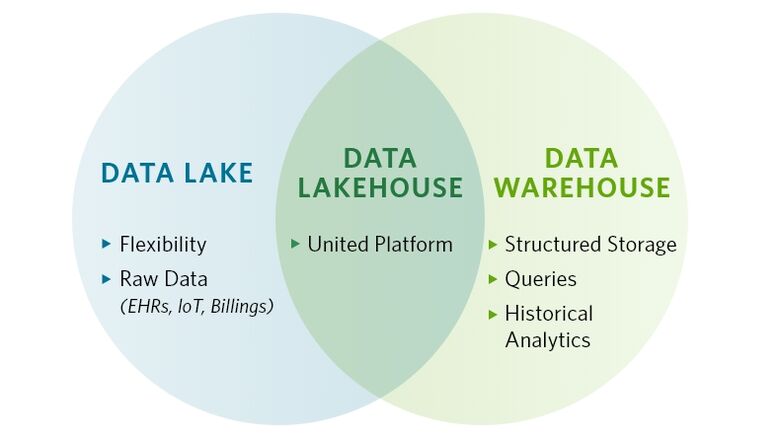
Data lakes and data warehouses represent two distinct paradigms in data management, each with its own strengths. Data lakes, known for their scalability and flexibility, allow the storage of vast amounts of raw data in its native format. This enables organizations to perform ad-hoc analysis and handle diverse data types. In contrast, data warehouses offer structured storage with optimized query performance, ideal for consistent reporting and analytics on historical data.
Databricks integrates these concepts through its innovative Data Lakehouse architecture, combining the best traits of both data lakes and data warehouses. This unified platform merges the scalability and cost-effectiveness of data lakes with the reliability and performance of data warehouses.
Transforming Healthcare RCM With Databricks Data Lakehouse
Databricks signifies a groundbreaking shift in how healthcare organizations can utilize data solutions to refine RCM. Its sophisticated data analytics capabilities enable healthcare providers to efficiently track claims, anticipate payment cycles and optimize revenue streams.
“By ensuring real-time data availability and consistent analytics across diverse datasets, the Databricks Data Lakehouse empowers healthcare organizations to extract holistic insights, making data-driven decisions that enhance both operational efficiency and patient care,” commented McDonald. “Databricks is our go-to platform, revolutionizing how we manage data.”
To accommodate the distinct needs of diverse healthcare organizations, from expansive hospital systems to individual practices, Cherry Bekaert delivers customized strategies to help clients address specific challenges, whether involving complex regulations or optimizing cash flow. “Recognizing the unique context of each provider ensures strategic insights that enhance financial resilience and operational growth,” commented McDonald.
By leveraging Databricks Data Lakehouse, Cherry Bekaert helps healthcare organizations revolutionize their data operations into a cohesive and data-driven ecosystem, providing:
- A reporting framework that enables analysis through a variety of dimensions
- A real-time 360-lens into enterprise-wide data
- A centralized repository for all data and reporting
- An established and trusted data governance infrastructure

Data Lakehouse Benefits for Healthcare Organizations
The integrated Data Lakehouse solution enhances claim tracking, predicts payment timelines and optimizes the revenue cycle while reducing payment delays, improving cash flow and providing predictive insights to address claim denial trends. By leveraging this solution, healthcare organizations can experience key benefits, including:
- Reduction in Denial
- Artificial Intelligence/Machine Learning (AI/ML) predicts denial likelihood before submission
- Automated compliance checks and coding assistance
- Natural Language Processing (NLP) to extract justifications from clinical notes
- Improvement in Days Sales Outstanding (DSO)
- Integrates data from electronic health records (EHRs), billing and claims
- Power BI dashboards for DSO, accounts receivable (AR) aging and denial trends
- Real-time insights for better decision-making
- Faster AR Cycle Times
- Clean, centralized financial data
- Actionable insights on denials and AR
- Faster claim follow-up and resolution
- Better billing transparency
- Improved Cash Flow
- Power Automate for routing notifications and decisions at critical decision points
- Power Apps to manage appeals, write-offs and task routing
The combined strengths of Databricks and Azure Data Platform allow healthcare companies to uncover valuable insights masked by the sheer volume and velocity of institutional data, visualize data effectively, predict cash flow with greater accuracy, and identify areas for operational improvement. This holistic data ecosystem drives enhanced decision-making capabilities while ensuring compliance, accelerating financial transformation and fostering a more proactive approach to managing accounts receivable.
“Ultimately, it enhances both efficiency and patient satisfaction by ensuring timely, accurate and compliant billing practices, giving healthcare providers the competitive edge needed to navigate the complexities of today's financial landscapes in the healthcare sector,” advised McDonald.
“Our unique implementation approach includes developing tailored data models to support healthcare-specific needs, like patient profit and loss (P&L) reporting and key performance indicator (KPI) tracking, incorporating subject area security and governance. We then migrate legacy reports and develop new data pipelines in the Lakehouse, enhancing existing data models with additional healthcare data sources. Finally, we enable advanced analytics and machine learning capabilities, such as integrating large language models and MLFlow, to transform raw data into actionable insights for improved patient outcomes.”
Data Lakehouse Use Case At Work
A manufacturing and consumer goods PE portfolio company needed to define key metrics and modernize its reporting and analytics capabilities. The organization elicited help from the team at Cherry Bekaert to develop a reporting strategy across multiple sites. Cherry Bekaert developed a data architecture and repository for the company’s data lakehouse.
Next, the team onboarded multiple Epicor enterprise resource planning (ERP) instances from disparate data sources such as ADP, Target, budget data and Advanced Manufacturing Execution System. Cherry Bekaert then developed key Power BI dashboards for order tracking, profitability (margin analysis, unit metrics, pricing variability, margin initiatives) sales analysis and open order details.
Enhanced strategic analytics capabilities and usage of reports and dashboards for customer operations were deployed, driving greater visibility into KPIs. Additionally, the executive team now leverages daily and monthly reporting to drive proactive outcomes.
For a healthcare company, this approach can be adapted to unify data from disparate clinical, operational and financial systems, enabling real-time insights across the organization. By leveraging a similar architecture to Power BI dashboards, organizations can better monitor patient outcomes or resource allocation.
“As healthcare organizations seek to modernize their operations, two critical areas have emerged: effective healthcare financial planning and the integration of AI in healthcare billing. These focus areas not only improve fiscal resilience but also streamline billing processes through intelligent automation and predictive analytics.”
Why Data Lakehouse Architecture Matters for Healthcare AI Tools
Data Lakehouse architecture is instrumental in organizing and preparing data for AI tools, which are becoming increasingly vital in healthcare applications. By bridging the gap between data lakes and data warehouses, the Data Lakehouse provides a unified framework that facilitates efficient data processing and analysis.
For healthcare organizations, this architecture ensures that vast quantities of diverse data types — ranging from patient records to billing information — are readily accessible and optimally structured for AI algorithms. This enables AI tools to deliver timely insights into patient outcomes, optimize resource allocation and enhance diagnostic accuracy.
International Data Corporation (IDC) research reveals that preparing data to yield optimal AI results has a strong bottom-line effect on the business, delivering a fivefold improvement in customer retention as well as strong gains in profit, efficiency and revenue. “In essence, the Data Lakehouse architecture empowers healthcare systems to leverage AI's full potential, ensuring mature data while driving advancements in patient care and operational efficiency,” emphasized McDonald.
For example, AI/ML could predict the likelihood of a claim submission being denied, enabling smarter workflows and reducing manual effort. These innovations represent the growing role of AI in healthcare billing, among other operations.
Your Guide Forward
Cherry Bekaert navigates the complexities of healthcare financial management by aligning cutting-edge technology with tailored approaches. Our Digital Advisory professionals deliver solutions where exceptional patient care aligns with robust financial health and operational resilience.
By integrating Databricks with the Azure Data Platform, healthcare providers are empowered to develop a scalable Lakehouse model that transforms their data into a strategic asset. Experience the transformative power of the Databricks Lakehouse for healthcare.
Contact us today to learn how our tailored solutions can elevate your data strategy, improve patient outcomes, and enhance operational efficiency.