


The Opportunity Zone (OZ) program, established under the Tax Cuts and Jobs Act of 2017, was designed to stimulate long-term investment in economically distressed communities. Investors who reinvested capital gains into Qualified Opportunity Funds (QOFs) were granted two key tax benefits:
- Deferral of the original gain until December 31, 2026
- Potential exclusion of future gains if the investment is held for at least 10 years
As the 2026 recognition deadline approaches, investors must prepare for the mandatory recognition of deferred capital gains, a process that hinges on the fair market value (FMV) of their OZ investments.
Understanding the Expiration of the OZ Capital Gains Deferral
On December 31, 2026, investors must recognize the deferred gain from their original investment. The IRS will tax the lesser of 1) the original deferred gain or 2) the FMV of the QOF investment on December 31, 2026. This provision introduces a critical planning opportunity. If the investment has declined in value, the FMV may be lower than the deferred gain, potentially reducing the tax liability. However, it also requires a credible and defensible valuation to substantiate the FMV used in tax reporting. Conversely, if the investment has appreciated, the deferred gain remains the taxable amount.
Why the OZ Tax Deferral Deadline Makes Valuation Essential
Valuation is not merely a compliance formality — it is a strategic tool. A properly substantiated FMV can:
- Lower the recognized gain and associated tax burden
- Provide defensible documentation in case of IRS scrutiny
- Enable accurate reporting under evolving OZ regulations
Without a valuation, investors may default to recognizing the full deferred gain, even if the value of their investment has declined. This could result in unnecessary tax payments and missed opportunities for tax optimization.
Valuation Requirements and IRS Expectations
Valuation of OZ investments must adhere to IRS standards for FMV, which generally require:
- Use of accepted valuation methodologies (e.g., income approach, market approach)
- Documentation of assumptions, inputs and valuation date
- Independence and expertise of the valuation provider
For real estate-based QOFs, appraisals must reflect market conditions as of the recognition date. For operating businesses, discounted cash flow (DCF) models or comparable company analyses may be appropriate. The IRS may scrutinize valuations that appear artificially low or lack sufficient support
OZ Gains Deferral Expiration Tax Implications and Liquidity Planning
The tax liability triggered in 2026 will be due by April 15, 2027, aligning with the standard tax filing deadline. The recognized gain will be taxed at the applicable capital gains rate at federal and state levels, if applicable. Importantly, the tax is due even if the investment remains illiquid.
Because many OZ investments are illiquid, especially those tied to real estate or long-term business ventures, this creates a “phantom income” scenario for many investors — where the tax liability arises without a corresponding liquidity event.
Investors should begin planning now to:
- Ensure liquidity through refinancing, secondary sales or distributions
- Consider tax loss harvesting strategies in 2026 to offset recognized gains
- Coordinate with advisors to align valuation timing and documentation with IRS expectations

Fund Managers: Coordinating Compliance and Value
Fund managers are central to the OZ ecosystem — not only as stewards of capital but also as facilitators of compliance. As the 2026 deferred gain recognition deadline approaches, their role becomes even more critical.
Why Fund Managers Must Act
Fund managers are uniquely positioned to:
- Coordinate valuations across the investor base
- Engage qualified valuation professionals with expertise in OZ structures
- Ensure consistency in methodology and documentation
- Support IRS compliance under evolving reporting standards
Without centralized coordination, investors may face:
- Inconsistent or unsupported fair market value assessments
- Higher individual costs for valuation services
- Increased risk of IRS scrutiny or audit
Action Items for Fund Managers
To support their investors and maintain fund integrity, managers should:
- Initiate valuation planning in Q1 2026
- Engage independent valuation firms with OZ experience
- Document valuation assumptions and methodologies
- Communicate timelines and expectations to investors
- Prepare for enhanced IRS reporting on fund performance, job creation and community impact
Fund managers who take these steps not only reduce risk but also enhance investor trust and fund credibility.
Investors: Prompting Your Fund Manager
Investors should not wait passively. Instead, they should proactively engage their fund managers with clear, informed requests. Suggested language includes:
“I understand that the IRS will require recognition of deferred gains in 2026 based on fair market value. To ensure compliance and optimize my tax position, I’d like to request a formal valuation of my OZ investment. Can you coordinate this for the fund?”
“I’ve read that group valuations can reduce costs and improve consistency. Please consider engaging a valuation firm to support all investors in the fund.”
“Can you confirm the timeline for valuation planning and reporting? I want to ensure I’m prepared for the April 2027 tax deadline.”
This kind of direct communication helps fund managers prioritize valuation planning and demonstrates investor awareness of regulatory obligations.
OZ Valuation Timeline for Action
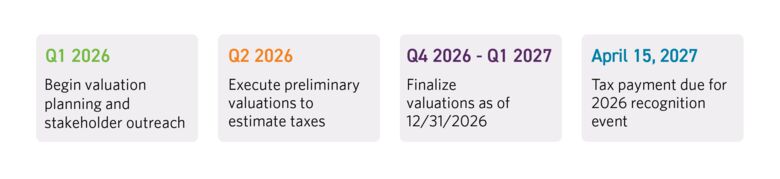
To ensure a smooth and compliant recognition process, both investors and fund managers should begin preparing well in advance of the 2026 deadline. Below is a recommended timeline to guide planning and execution:
Cherry Bekaert Can Guide You Through OZ Valuation and Tax Planning
The 2026 deferred gain recognition event is a pivotal moment for OZ investors. Accurate valuation is not just a compliance requirement — it is a strategic necessity. Investors and fund managers must act now to ensure defensible FMV assessments, align liquidity with tax obligations and preserve the benefits of the OZ program.
With decades of experience in valuation, tax strategy and OZ compliance, Cherry Bekaert is uniquely positioned to support both investors and fund managers through this process. We offer IRS-compliant valuation services, discounted group pricing for fund managers, and strategic tax planning and reporting support. To begin your valuation planning and establish readiness for the 2026 recognition event, contact Cherry Bekaert’s OZ and Valuation professionals today.