


An initial public offering (IPO) is a significant milestone in the business lifecycle, and the transition from private to public status requires careful planning and strategic processes to avoid obstacles. To help you prepare, this IPO timeline guide covers the general stages and timeframes leading up to listing day and beyond.
What is an IPO?
An IPO is when a private company offers initial shares of its stock for public sale — “going public” — in an effort to raise capital. An IPO:
- Increases a company’s brand visibility and credibility
- Allows the company to use publicly traded stock as currency for acquisitions and employee incentives
- Broadens access to a diverse institutional investor base
- Makes future capital raises easier and more efficient
- Provides founders and early investors with clearer liquidity and succession planning options
The IPO process is complex, and businesses must prepare for Public Company Accounting Oversight Board (PCAOB) standards and U.S. Securities and Exchange Commission (SEC) regulations to which they were not subject as private companies. Managing your IPO timeline organizes and facilitates readiness efforts so organizations can track what steps need to be taken and when.
How Long Does the IPO Timeline Take?
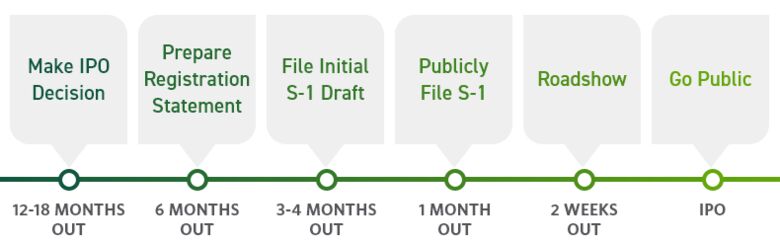
An IPO typically takes 12 to 18 months to execute from decision to listing day. If the process is well organized, key IPO preparation steps take roughly six to nine months.
Stages in the IPO Timeline
Depending on the company’s state of readiness, IPO preparation may last six months or over two years. Many stakeholders are involved in the process, making it essential to have a clear roadmap for groups to follow. In addition to stakeholder involvement, it’s common to collaborate with third-party service providers, such as underwriters, accounting and audit firms, SEC filing and printing services, legal counsel service providers, and transfer agents.
Below, we break down the main stages of an IPO timeline.
Stage 1: IPO Planning & Readiness (12 – 18 Months Prior)
Following the initial decision to take the company public, the first stage involves high-level IPO readiness and preparation. Businesses typically perform an internal assessment of operations, financial reporting, internal controls and corporate governance to determine any gaps that need attention to align with public company requirements. Other key activities include:
- Determining SEC filer status
- Assessing accounting practices against public company standards
- Evaluating audit readiness
- Selecting third-party advisors, if needed
PCAOB audits may cause delays at this stage, as the audit process is often one of the most arduous, time-consuming efforts. Once companies are ready to move to the next stage, they will have identified gaps to close and developed a comprehensive IPO strategy.

Stage 2: Pre-filing (3 – 6 Months Prior)
As companies move closer to filing with the SEC, this stage involves implementing operational changes and engaging underwriters to manage issuance during the IPO process. Other key activities include:
- Preparing your Form S-1, the mandatory registration statement which may initially be filed confidentially before disclosing detailed financial information and management information
- Completing PCAOB audits
- Developing a leadership team with experience at public companies
Stage 3: Roadshow, Pricing and Effectiveness (1 – 2 Months Prior)
The final months focus on the SEC review process and preparation for investor scrutiny. Form S-1 filings will be reviewed and submitted during this stage, and businesses will need to effectively manage SEC filing timelines and respond to SEC comment letters. Additionally, investment banking teams address numerous additional tasks, including:
- Determining value and price setting
- Collaborating with underwriters to prepare roadshow presentations
- Finalizing IPO documentation and offer structure
Form S-1 must be publicly filed at least 15 days before the launch of a roadshow, a series of meetings where the private company pitches itself to potential investors to generate interest and determine the final share price.
The roadshow of investor meetings may last between seven and 14 days. The feedback received during a roadshow can help determine final pricing and terms, and investors are given early buy-in opportunities. Once the roadshow is over, management will meet with bankers to set the final IPO price. Trading can begin the day after pricing when the market opens, meaning the company has officially completed an IPO.
After You Are Public
After an IPO, companies face shifting priorities and extensive quarterly reporting, on top of new regulatory compliance demands. While the lead-up to a public offering is both extensive and exhilarating, post-IPO priorities can add new workloads to stretched teams. To sustain momentum following an IPO, management must consider:
- Sarbanes-Oxley (SOX) compliance and certification
- Data governance and security
- Scaling systems to support growth
- Continuous compliance testing and recurring quarterly reviews and annual audits
- Building market-driven transparency with investors
The first year as a public company can expose operational gaps and growing pains, but a deliberate plan to address ongoing issues can help businesses maintain stability during high-growth stages.
IPO Timing Factors To Consider
Deciding to go public is a major turning point and requires careful consideration of market conditions, industry-specific characteristics and internal readiness.
A successful IPO and optimal valuation hinge on assembling a skilled, dedicated team capable of executing swiftly and efficiently in response to market conditions. The ability to move quickly is especially important given the unpredictable nature of market volatility and geopolitical events, both of which can dramatically impact investor sentiment. When strong investor demand arises, companies must be poised to act — timely execution often separates successful IPOs from those that miss critical windows of opportunity.
Readiness to launch an IPO at the right moment requires both close monitoring of market signals and adequate internal preparedness. One of the most significant timeline drivers is the alignment of internal resources and processes. The business must ensure it has the right talent and leadership in place to manage the full IPO timeline, from initial readiness assessments to roadshow presentations and listing day logistics. The company must also assess its ability to afford the costs associated with going public and prepare for ongoing compliance in a post-IPO environment.
Additional timeline drivers include market conditions, industry-specific factors, and regulatory requirements. Each phase requires careful planning and swift decision-making to ensure the company can capitalize on favorable market conditions and respond to investor interest in real time. Ultimately, readiness is a combination of internal capability and external awareness. Being prepared to execute quickly is essential for a successful public offering.
Your Guide Forward
Each phase of the IPO timeline presents unique challenges and opportunities, from the readiness assessment to the roadshow and listing day. To position your company for a successful public debut, it is crucial to invest time in thorough preparation across all aspects of the business.
Cherry Bekaert’s professionals help management set a clear, realistic IPO process timeline and readiness checklist to prepare and execute your IPO. Our co-sourcing approach involves experienced CPAs at every stage of the journey, allowing your in-house team to focus on the other key day-to-day elements of their job.
Our Accounting Advisory Services practice collaborates closely with CFO Advisory Services professionals to deliver a knowledgeable, tailored plan for a successful IPO launch. Connect with an advisor today to learn more about Cherry Bekaert’s IPO offerings.