Transforming the Office of the CFO
Moving beyond finance powered by people fiscal stewardship, professional services chief financial officers (CFOs) are getting more involved in strategic decision-making and technology initiatives, but regulatory changes, competitive pressure and siloed data are hindering forecast accuracy and organizational agility.
To help their firms modernize, finance leaders are placing a greater emphasis on scenario planning and analytics to generate insights into engagement economics, such as utilization, realization, pricing discipline and work-in-progress (WIP) to billing, so that decisions on staffing, scope and cash move faster while maintaining control.
Professional services refer to people-intensive businesses that offer specialized knowledge and support, such as law, accounting, and engineering firms. Professional services firms, in particular, require strategic insight into capacity, market dynamics and efficiency in service delivery.
Cherry Bekaert surveyed CFOs and senior finance executives at U.S. enterprises with revenue between $5 million and $250 million across various industries, including professional services, to better understand the current and future trajectory of their modernization efforts.
Key Modernization Insights for Professional Services CFOs
1. Digital transformation is happening.
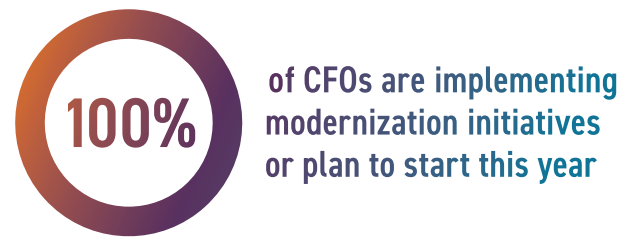
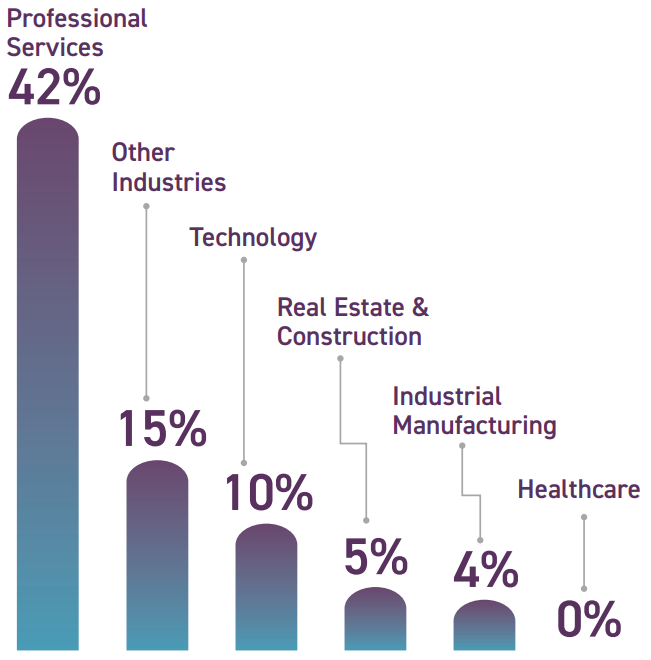
100% of professional services firms either already modernizing or planning to do so this year, yet many are still strengthening their foundations. Nearly half (42%) are just transitioning from paper to cloud-based systems. With 62% citing unclear ROI alongside persistent data integration and reporting challenges, finance leaders must first establish a clear vision and connect core data with workflows — using management workflow automation as a practical starting point — before layering on more advanced technologies.
Industries digitizing from paper to a modern technology
2. Fragmented systems and data disarray are slowing firms down.
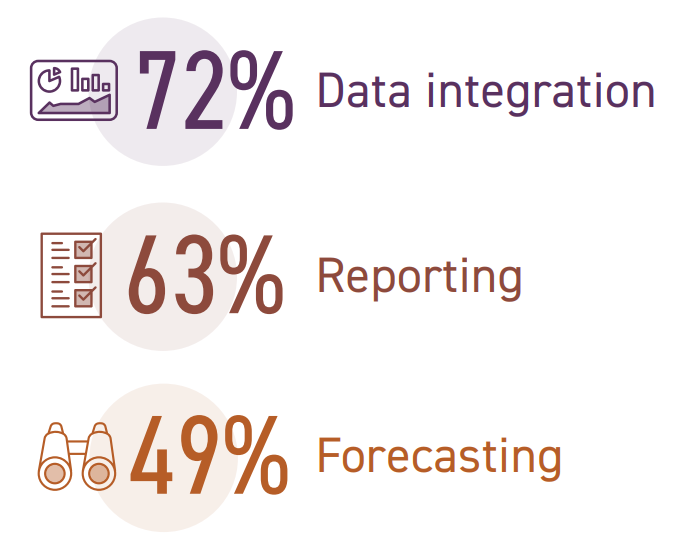
Professional services finance leaders reported data integration (72%), reporting (63%) and forecasting (49%) as their top pain points, all mission-critical issues in an industry where readily available, trustworthy insights are needed for capacity, utilization and pricing decisions. Disconnected or underutilized enterprise resource planning (ERP), professional services automation (PSA), customer relationship management (CRM) and other systems are being patched together by spreadsheet-heavy workarounds that bog down teams and slow billing cycles, client delivery and resource planning.
3. Future-ready talent is the binding constraint — skills over seats.
People will always be professional service firms’ greatest asset, but only 10% see hiring as a top five priority for finance in the next 12 months. Increasing their team’s accounting or finance expertise (58%) and comfort with technology (44%) are more significant to finance operations and modernization efforts.
4. The infrastructure for modernization is still being built.
Only 46% of professional services respondents report working to automate processes or transform operations, compared to 63% across all industries. This disparity highlights how challenges with data integration and reporting, along with reliance on paper or spreadsheet‑based workflows, are slowing firms down. At the same time, 60% cite an increased focus on technology and data strategy, with CFOs leading efforts to establish structured, well‑governed data across areas such as time and
5. Growth focus and M&A activity remain strong.
Company expansion and growth are strategic imperatives for 58% of professional services finance leaders, consistent with overall responses. However, for professional services, mergers and acquisitions (M&A) were a substantially higher priority, with 44% reporting increased involvement in M&A over the last 12 months and 60% who say making or integrating acquisitions is a key focus for the next 12 months (compared to 16% and 26%, respectively, overall). Transaction data shows professional services captured nearly 19% of private equity (PE) deals in the third quarter of 2025.
One of the most active areas within the sector was the accounting and CPA segment, with more than 50 PE-related transactions estimated to have occurred in 2025. Sponsors doubled down on consolidation of a highly fragmented industry with predictable demand and strong recurring revenues, and nearly half of the top 30 CPA firms in the U.S. now have some form of PE investment. With increasing M&A, professional services firms must focus on aligning teams on common platforms to fully leverage new operational capacities.
“The survey shows professional services firms are committed to modernization, but many are still building the foundation. Fragmented data, unclear ROI and spreadsheet‑driven workarounds are slowing forecasting, billing and growth. The CFOs making progress are defining a clear vision first — connecting data, strengthening governance and modernizing workflows before adding new technology.”
Key Trends for Professional Services CFOs in 2026
Modernization is universal but immature. While all firms are focused on modernizing, many still operate with a mix of manual and cloud-based systems and struggle to demonstrate clear ROI. These fragmented systems are one of the biggest obstacles to modernizing finance functions. Behind siloed systems, data integration, reporting and forecasting remain top pain points.
Talent gaps pose an additional problem, as businesses discover employees may not have the data literacy and systems knowledge needed to enable modernization. This has made hiring a low priority. Instead, firms are upskilling finance teams in accounting expertise and technology. Lastly, growth and M&A raise the stakes. With elevated acquisition activity, firms must standardize platforms and data quickly to realize scale, efficiency and profitability gains in 2026.
Book a Complimentary Finance Modernization Diagnostic to Guide Your 2026 Roadmap
How To Unlock Modern Finance in Professional Services
Professional services finance modernization will be defined by speed with control: leaders who create clean, connected data and pipeline and backlog-driven cadences can help improve engagement economics and develop scenario-ready plans to respond quickly to change. Harmonizing systems and setting rules for the numbers will enable firms to prepare for and integrate acquisitions and expand geographic footprints while maintaining compliance, protecting margins, growing revenue and demonstrating return on strategic investments.
1. Bring data, systems and workflows together to unlock a single view of engagement economics.
Without connected data and clear definitions, firms face slower billing cycles, manual revenue adjustments, acquisition integration hurdles and reactive forecasting. Start by retiring spreadsheets, aligning CRM, ERP, PSA, FP&A and business intelligence, and publishing a lightweight metrics catalog (owner, source, refresh cadence, quality threshold) for utilization, realization, margin by service line, backlog burn, WIP aging and days sales outstanding (DSO).
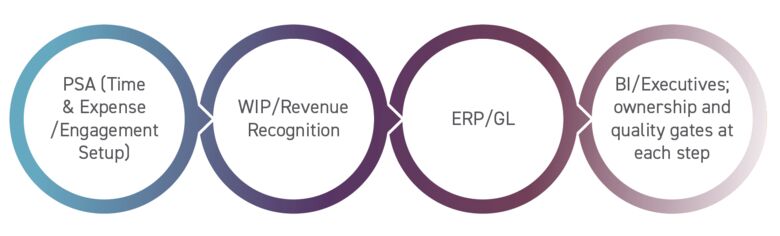
This foundation enables finance to move from assembling numbers to governing them, reducing manual touches and enabling faster calls on pricing, staffing and billing holds. Make “time-to-decision” a finance key performance indicator (KPI) to demonstrate return on investment (ROI).
2. Move forecasting from hindsight to pipeline driven cadence.
Forecast accuracy improves materially when it is tied to CRM pipeline and funded backlog rather than purely historical run rates. Implement a rolling forecast that considers opportunity probability, expected start dates, staffed capacity and planned rates, and automate engagement-level profit and loss (P&L) and WIP aging to reduce reconciliations. Incorporating real-time signals and scenario-specific parameters increases agility and shortens the cycle from signal → tradeoff → action for pricing and staffing decisions, and less manual intervention improves audit readiness.
| Stage | CRM/ Pipeline | Backlog | Staffed Capacity | Delivered Hours/ Fees | Billed | Cash |
|---|---|---|---|---|---|---|
| GATE | SOW Scope | Rate Card | Milestone Plan | Milestone Acceptance | Discount Guardrails | |
| KPIs | Weighted pipline Win Rate |
Funded backlog Burn |
Utilization Capacity |
Realization Margin by service line |
Billing velocity WIP aging |
DSO Collections effectiveness |
Governance gates ensure speed with control across the engagement lifecycle. Measure impact with two metrics: manual‑touch reduction and signal → action cycle time.
3. Build an M&A playbook to maintain integrity and momentum.
Given the emphasis on company growth and M&A in professional services, firms need a ready-to-go and repeatable approach to acquisitions and multi-office rollups that supports the synergies of the original deal thesis, whether that is expansion of capabilities or the creation of new offerings.
Create a standard chart of accounts harmonization, KPI taxonomy, PSA/ERP data migration plan, rate card alignment and statement of work (SOW) governance, and then run 30/60/90-day sprints with success measures tied to days to bill, time to decision and DSO. This derisks synergy assumptions, prevents spreadsheet sprawl post close and protects engagement economics while scale is added.
4. Embed regulatory readiness and fraud, cyber and AI guardrails into core finance workflows, then automate.
Professional services firms are actively implementing or planning modernization initiatives in a shifting regulatory environment with evolving work models, making compliance, audit readiness and information security critical considerations as they move forward.
CFOs can build compliance and control into workflows by codifying documentation standards for revenue processes (time and expense, WIP → billing, realization), enforcing role-based access and audit trails in key systems, and keeping a standing audit ready pack (engagement level P&L, evidence of milestone acceptance, billing holds, collection notes). Optimized workflows and data discipline create opportunities to automate and introduce artificial intelligence (AI) into reconciliations or anomaly detection, while keeping accounting staff involved and setting explicit client data boundaries to maintain trust and regulatory confidence.
5. Tie modernization to engagement economics to prove ROI.
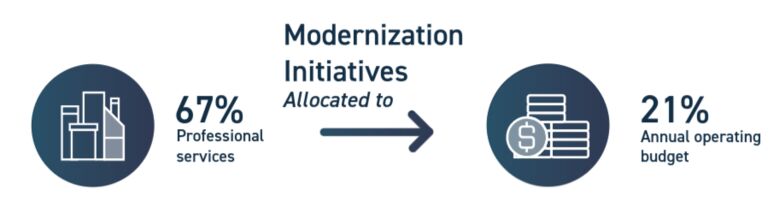
Of the professional services respondents, 67% reported that more than 21% of their annual operating budget is currently allocated to modernization initiatives (compared to 27% overall), but unclear ROI was the top impediment to their efforts. To build and sustain momentum (and budgets), link modernization to engagement economic outcomes and publish a scorecard for your executive team quarterly to show value creation.
Looking Ahead for Professional Services
With a few focused improvements, many professional services CFOs are well positioned to turn modernization into an operating advantage. Firms that integrate data flows (PSA → ERP → BI), standardize core monthly processes (close, AP/AR, forecast, billing) and enhance reporting to deliver trusted and decision-ready engagement analytics can move from assembling numbers to governing them. This allows you to convert insight into faster, confident decisions on pricing, staffing and cash.
Start by setting rules for the numbers, shifting forecasting to a pipeline and backlog driven cadence and automating engagement level P&L and WIP aging. The enhancements can drive your modernization efforts:
- Reduce manual touches and days to bill
- Improve audit readiness and decision velocity
- Create a durable foundation for AI
- Set firms up for M&A success
Using short, targeted sprints, CFOs can make quick gains and lock in habits that create and maintain clean data, improve forecasting, embed compliance in workflows and translate investment into engagement excellence, improved margins and sustainable growth.
12 Actions for CFOs To Modernize
A Practical Playbook for Professional Services Leaders
|
||
| Why this matters: Skills — not headcount — are the constraint. |
Survey insight: Only 10% of professional services CFOs list hiring as a top priority, while 58% are focused on increasing finance/ accounting expertise and 44% on improving technology skills. |
|
| 1. Run finance like a product Assign owners to FP&A and reporting so priorities are clear and improvements stick. |
2. Name automation champions Empower owners in AP/AR, forecasting, and variance analysis to reduce manual work. |
3. Build PSA, BI, and audit skills Train teams on utilization, realization, engagement P&L, and WIP to billing controls. |
 PEOPLE
|
||
| Why this matters: CFOs need speed with control, not more complexity. |
Survey insight: 49% of professional services CFOs cite forecasting as a top pain point, driven by spreadsheet-heavy, disconnected processes. |
|
| 4.Standardize core finance cycles Simplify close, AP/AR, forecasting, and billing; eliminate spreadsheets. |
5. Forecast from the pipeline Tie forecasts to CRM pipeline and funded backlog with clear triggers for action. |
6. Use a repeatable M&A playbook Apply 30/60/90day integration steps and track days to bill and DSO. |
 PRocess
|
||
| Why this matters: Fragmented data is the biggest blocker to insight. |
Survey insight: Professional services CFOs report data integration (72%) and reporting (63%) as their top challenges—higher than any other industry. |
|
| 7. Set clear rules for KPIs Define metric owners, sources, refresh timing, and quality standards. |
8. Show how data flows Map CRM → PSA → ERP → BI with controls and audit trails. |
9. Keep auditready records Maintain engagement P&L, milestone approvals, billing holds, and collections notes. |
 DATA
DATA
|
||
| Why this matters: Investment is high, but ROI must be proven. |
Survey insight: Only 46% of professional services firms are actively automating today, yet 67% allocate more than 21% of their operating budget to modernization — and unclear ROI is the top barrier. |
|
| 10. Integrate before upgrading Connect PSA, ERP and BI to get one view of engagement economics. |
11. Automate trusted processes Start with reconciliations, AP/AR matching, WIP review and variances. |
12. Use AI carefully Apply AI with human review, rolebased access and clear client data boundaries. |
 TECHNOLOGY
Why Choose Cherry Bekaert for Finance Modernization
We understand the middle market because it has been our focus from the start. We have successfully guided clients through various stages of growth, allowing us to understand the evolving landscape and the critical factors that drive success.
At Cherry Bekaert, we empower companies to modernize their finance function with a people-first, performance-driven approach. By aligning strategy, technology and talent, we help CFOs eliminate inefficiencies, unlock real-time insights, and build scalable processes that drive accuracy, agility and growth.
Our tailored roadmap delivers quick wins in the first 30/60/90 days while laying the foundation for long-term transformation — turning finance into a catalyst for enterprise-wide results.
Let us be your trusted advisor. cbh.com/modernfinance