


When your city becomes the epicenter of excitement — whether for a championship game, music festival, political convention or global sporting event — demand for lodging skyrockets. Hotels sell out months (or years) in advance, nightly rates surge, and travelers begin searching for alternatives that offer space, convenience and proximity.
For homeowners, this creates a unique opportunity: a short window to generate meaningful income by renting your primary residence, often at premium, event-driven rates. Even better, if structured properly, that income may qualify for tax-free treatment under the Augusta Rule (IRC Section 280A(g)). At the same time, those who choose to rent beyond occasional event weeks may unlock additional long-term tax benefits through short-term rental (STR) classification and cost segregation studies.
This expanded guide integrates new market insights, real-world examples and event-driven rental trends to help you price effectively, prepare strategically and maximize both income and tax advantages.
The Augusta Rule: A Rare Tax-free Income Opportunity
For homeowners in cities hosting major events, the Augusta Rule represents one of the most powerful, yet often overlooked, tax opportunities available. It allows homeowners to monetize rent received in a short period, completely tax-free.
Under the Augusta Rule, you can rent out a residence for up to 14 days per year without owing federal income tax on the rental income. This makes it especially attractive during large-scale events, where short windows of exceptionally high demand naturally drive-up fair market rental rates.
To qualify for tax-free treatment:
- You must use the home personally for more than 14 days per year (or 10% of rental days).
- You may only rent the home for 14 days or less during the calendar year.
- Provide support that the arrangement is a bona fide rental, you must charge a rate comparable to similar properties.
- Rent a dwelling unit used as a residence (including your vacation unit) to adhere to the Augusta Rule.
Because major events temporarily inflate local rental pricing, often dramatically, homeowners can command premium nightly rates while staying squarely within fair-market value (FMV) guidelines. This unique combination of high demand and favorable tax treatment is what makes event-week renting so financially compelling.
Short-term Rental Rules: When You Exceed 14 Days
Once you rent your home for more than 14 days a year, you can no longer use the Augusta Rule. At that point, the Internal Revenue Service (IRS) considers the activity rental income, and STR rules generally apply.
If your rental usage exceeds the 14-day threshold:
- All rental net income becomes taxable.
- You must report rental activity (typically on Schedule E).
- Expenses must be allocated between rental and personal days, typically based on days used for each purpose, and deducted in a prescribed order.
- Local STR rules may require permits, licenses or lodging tax collection.
For homeowners renting during both high-demand event weeks and additional weekends or holidays, it’s common for the property to cross into STR territory. While this eliminates tax-free treatment, it also unlocks a set of powerful deductions and depreciation strategies not available under the Augusta Rule.
Material Participation Requirements
For STRs to fully benefit from deductions and potential losses, the IRS generally requires the owner to materially participate in the activity. This means spending a significant amount of time managing the rental, such as handling guest communication, maintenance and pricing decisions.
Meeting material participation tests can determine whether your STR income is treated as passive or nonpassive, which directly affects your ability to deduct losses. This rule does not apply under the Augusta Rule because no rental income is reported.
Cost Segregation Advantages for STR Owners
If your home transitions into a full or frequent STR, cost segregation studies can create substantial tax savings by accelerating depreciation.
Through cost segregation, you can:
- Depreciate certain components of your home on shorter schedules.
- Capture larger deductions earlier, reducing taxable rental income.
- Benefit from bonus depreciation (when available under tax law).
Though cost segregation does not apply under the Augusta Rule because the rental income is not taxable, it becomes a major advantage once your home operates as an STR for more than 14 days per year.
Pairing Strategies: Hybrid Approaches for Maximum Benefit
The optimal approach depends on your goals, event frequency in your city and how actively you want to host.
Option 1: Use the Augusta Rule Exclusively
- Rent your home for up to 14 days.
- Earn tax-free income.
- Avoid STR regulatory complexities.
Option 2: Operate as an STR Business
- Rent more than 14 days.
- Gain access to deductions, depreciation and cost segregation.
- Capture ongoing rental income beyond event windows.
Option 3: Combine Both Approaches
- Use major events as a low‑risk test run for hosting.
- Transition to STR status if rental demand and economics justify a more formal approach.
- Build a tax strategy that aligns with your long‑term objectives.

How To Price Your Home for Event Rentals Without Jeopardizing FMV Requirements
Event driven pricing is both an art and a science, and understanding how different event types influence demand helps you set competitive, fair market rates. To maximize opportunity while staying compliant, follow the tips below.
1. Monitor Comparable Listings
Review Airbnb, VRBO and local vacation rental platforms in the months leading up to the event. Rates often rise sharply as demand increases, especially for large-scale events.
2. Use Hotel Pricing as a Benchmark
Hotels frequently adopt aggressive dynamic pricing during major events, sometimes increasing rates by 200% or more. Their availability, rate increases and minimum stay requirements can help validate your fair market value.
3. Time Your Pricing Adjustments
Prices typically climb as the event approaches, and lodging inventory tightens. Dynamic pricing tools can help automate rate adjustments, so you remain competitive without underpricing your home.
4. Understand Market Realities Based on Event Type
Not all events generate the same rental premium. Knowing the event tier helps you anticipate demand and price accordingly:
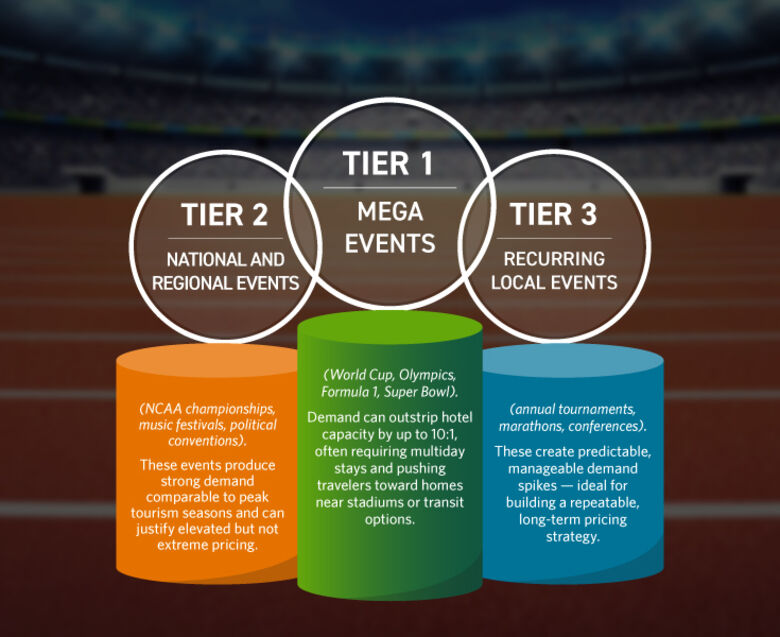
Understanding your event category helps you set realistic rate ranges, anticipate booking behavior, and maximize revenue while staying within fair market guidelines.
Preparing Your Home for Event-week Rental Success
Major events attract discerning travelers — families, groups, VIPs and corporate guests — who are willing to pay a premium for homes that feel comfortable, functional and thoughtfully designed. Preparing your home with both essential hosting practices and strategic upgrades ensures it stands out in a crowded market and commands higher nightly rates.
Core preparation steps include:
- Secure valuables and personal items to protect your belongings during guest stays.
- Hire professional cleaners before and after each booking to provide a hotel-level experience.
- Offer a comprehensive home guide with Wi-Fi details, appliance instructions, check-in procedures and local recommendations.
- Ensure full safety compliance, including working smoke detectors, carbon monoxide alarms and secure locks.
- Stock key essentials such as fresh linens, toiletries, paper goods and well-organized kitchen basics.
In addition to these fundamentals, simple design upgrades can dramatically improve your listing appeal and booking conversions. Enhanced lighting, updated bedding and décor, thoughtfully arranged common areas, and welcoming outdoor setups make your home look more polished in photos and deliver a more comfortable stay. These enhancements justify premium pricing and make your listing more competitive, increasing both guest satisfaction and conversion rates during peak event weeks.
The Realities and Risks of Event-driven Hosting
While renting your house for events can be highly lucrative, it’s important to approach the opportunity with a clear understanding of the risks and operational demands involved. Event week guests often arrive in large groups, stay for multiple days and expect hotel-level service — conditions that can increase wear and tear on your property. There is always a possibility of property damage, whether from accidental spills or more substantial misuse, and homeowners may need to invest in upgraded furniture, décor or outdoor amenities upfront to attract higher-paying guests.
Another challenge is unpredictable booking timelines. Some events drive early demand, while others fill last minute as schedules finalize or teams qualify. This can make it difficult to forecast revenue and prepare accordingly.
In addition, short-term rental regulations continue to evolve, and homeowners must navigate local permitting, tax requirements, and policy changes, particularly in cities responding to increased tourism. This can make it difficult to forecast revenue and prepare accordingly. Evolving regulations can also result in changes to insurance protections and policies.
Working with an insurance broker can be a valuable tool in determining if you have adequate coverage or need additional short-term rental insurance to cover things like host damage protection or business interruption. In addition, a business attorney should be consulted to provide legal entity structure advice to minimize risk of liabilities.
Finally, hosting during high-demand windows comes with heightened operational expectations: quick turnover between guests, responsive communication and the ability to troubleshoot issues on short notice. Understanding these realities helps ensure you plan effectively, price appropriately and avoid surprises.
Using Major Events To Test Your STR Strategy and Evaluate Tax Impact
For many homeowners, renting during a major event is their first step into short-term hosting, and it’s often the safest way to explore the market. Event weeks provide a clear, timebound opportunity to evaluate your comfort with hosting without committing to year-round rentals. You can observe how travelers respond to your home’s location, amenities and price point, giving you a real-world sense of demand in your neighborhood.
This trial period also allows you to experiment with pricing strategies, listing platforms and communication tools to form a better understanding of what it takes to manage bookings efficiently. If the experience is positive and the economics make sense, event-driven hosting can serve as a natural onramp into a more consistent STR strategy. Some homeowners choose to keep renting only during high-demand periods for supplemental income, while others use these event windows as a springboard into full-time STR operations with year-round revenue potential.
By treating event weeks as a low-risk test, you can make informed decisions about whether ongoing hosting aligns with your financial goals, lifestyle and tolerance for the demands of STR management.
Turn Major Events Into Financial Wins
Major events can transform your home into a high-value rental asset, even if just for a few days each year. Whether you leverage the 14-day, tax-free Augusta Rule or transition into STR ownership, thoughtful planning allows you to capture substantial income while maintaining compliance.
By understanding demand patterns, pricing intelligently, designing inviting spaces, and planning your tax approach, you can maximize returns during your city’s busiest and most exciting moments. Because the optimal approach depends heavily on your goals, event calendar and IRS classification, connect with your Cherry Bekaert tax professional to determine the most tax‑efficient strategy for your situation.