


Structure of the House of Representatives
The majority party effectively runs the House of Representatives (House), including electing the speaker, determining committee leadership, and setting the chamber’s legislative agenda. A minimum of 218 of the 435 seats in the House is needed for control when there are no vacancies. The composition of House committees generally reflects the overall ratio of the chamber, though it’s often weighted more heavily in favor of the majority party.
Most House actions are decided by a simple majority vote, although certain situations — such as overriding a presidential veto — require a two-thirds supermajority. The House majority is often able to exercise greater control due to its rules limiting debate and lack of procedural barriers, compared to the Senate.
Impact on Tax Policy
The House Ways and Means Committee has jurisdiction over tax and other revenue-generating legislation, tariffs and trade, and other federal programs such as Social Security and Medicare. Under the Constitution’s origination clause, revenue-raising measures, including tax bills, must originate in the House; however, the Senate is able to offer or approve amendments and has occasionally utilized “shell bills” to originate their own proposals.
The 119th Congress
The 119th Congress began its two-year term on January 3, 2025. Currently, Republicans hold a slim majority in the House with 219 seats (including 1 independent) to Democrats 212; 4 seats are currently vacant:

Current House leadership consists of:
| Speaker of the House | Rep, Mike Johnson (R - LA) |
| House Minority Leader | Rep. Hakeem Jeffries (D - NY) |
| Ways & Means Chair | Rep. Jason Smith (R - MO) |
| Ways & Means Ranking Member | Rep. Richard Neal (D - MA) |
Speaker Johnson and his leadership team have been operating with an exceptionally narrow and unpredictable Republican majority. This dynamic has made navigating the legislative landscape extremely complex at times — forcing the speaker to consider some bills under “suspension of the rules,” the withdrawal of planned votes, and the use of discharge petitions where Republicans have joined Democrats to force consideration of legislation opposed by the speaker.
The House has also seen an unusual number of departures during the 119th Congress, with members resigning, leaving for other offices, and several unexpected deaths.
| Seat | Departed Member | Reason | Successor |
| FL-01 | Matt Gaetz (R) | Admin Position (Abandoned) | Jimmy Patronis (R) |
| FL-06 | Mike Waltz (R) | Admin Position | Randy Fine (R) |
| TX-18 | Sylvestor Turner (D) | Death | Christian Menefee (D) |
| AZ-07 | Raúl Grijalva (D) | Death | Adelita Grijalva (D) |
| VA-11 | Gerry Connolly (D) | Death | James Walkinshaw (D) |
| TN-07 | Mark Green (R) | Resignation | Matt Van Epps (R) |
| NJ-11 | Mike Sherill (D) | NJ Governor | Analilia Mejia (D) |
| GA-14 | Marjorie Taylor Green (R) | Resignation | Clay Fuller (R) |
| CA-01 | Doug LaMalfa (R) | Death | Special Election on August 4 |
| CA-14 | Eric Swalwell (D) | Resignation | Special Election on August 18 |
| TX-23 | Tony Gonzales (R) | Resignation | Special Election To be Determined |
| FL-20 | Sheila Cherfilus-McCormick (D) | Resignation | Special Election To be Determined |
| GA-13 | David Scott (D) | Death | Special Election To be Determined |
2026 Midterms: The House
Control of the 120th Congress will be decided by the midterm elections. Members of the House of Representatives only serve two-year terms, meaning all 435 seats are up for election in 2026.
The House is typically the more difficult chamber to forecast — a challenge that is likely to be amplified in 2026 by the unusually high number of member departures and ongoing state redistricting efforts. At the same time, it remains the chamber most likely to flip; Democrats only need a net gain of three seats in the midterm to regain control of the House. Historically, the president’s party almost always loses seats in the midterms, particularly in the House.
As of August 19, 2026, 75 current House members have announced they will not seek re-election or lost their primary bids — 42 Republicans and 33 Democrats. This level of turnover, affecting more than 17% of House incumbents, is unusually high by recent historical standards. The resulting increase in open-seat races could have significant implications in the battle for House control, as open seats are generally more competitive than incumbent-held districts. Of the 74 departing members, 11 were defeated in primary elections, marking the highest number of incumbent primary losses in a non-redistricting year in more than 50 years.
Midterm Math
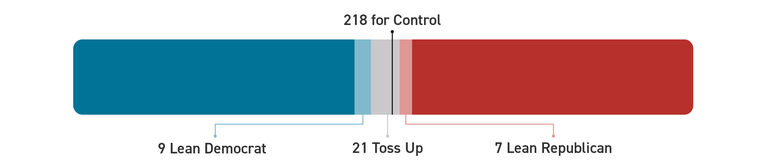
Democrats currently hold a slight advantage in the battle for control of the House, though the race remains highly competitive. Midterm elections have historically been challenging for the president's party, and control of the House frequently changes hands as a result. However, many of the most competitive races are concentrated in a relatively small number of districts, leaving little margin for error for either party. National political and economic developments could prove especially important in a battle for House control that may ultimately be decided by only a few seats.
Current ratings place the most competitive House districts in the following categories:

A total of 218 seats are needed to control the chamber:
Impact of Redistricting
State redistricting efforts will also influence the outcome of the 2026 midterms. While states are required to redraw congressional districts every 10 years after new census data is released, numerous states have enacted or are pursuing mid-decade changes, in what has become a redistricting blitz.
To date, 9 states have adopted new congressional maps for the upcoming 2026 election, though several are currently facing legal challenges. The chart below outlines estimated seat gains for each party across these states:
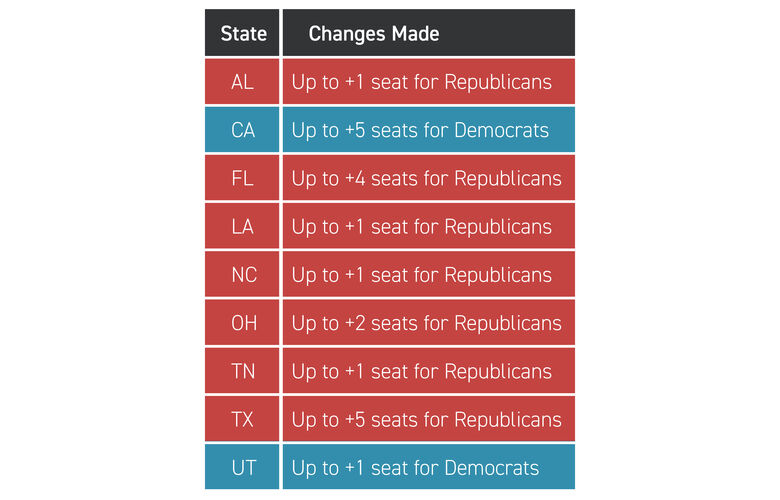
With less than three months until the election, redistricting efforts for the midterms have concluded. Recent map changes put Republicans in position to gain as many as 15 House seats, while Democrats could pick up as many as 6.
The ultimate impact of these redistricting efforts will not be clear until after the election, but they have the potential to meaningfully shift the balance of power in the House.
Back to Main Page: 2026 Midterm Elections and Implications for Tax Policy
Cherry Bekaert’s tax policy team will update this page as developments occur.