When Top Talent Moves On, Strong Leaders Maintain Momentum
No leader ever hopes for an unexpected resignation, especially when it involves a key contributor in the accounting function. Yet employee departures are an unavoidable reality, even in the best-run organizations. How leaders respond in those moments to keep the work and the team moving can either destabilize the organization or strengthen it.
Having spent more than two decades connecting business leaders with top-tier professionals to improve operational efficiency and financial performance, Cherry Bekaert Recruiting & Staffing Services Managing Director Doug Smith has seen how quickly a resignation — sometimes with plenty of notice, but often without — can create stress across an organization. Work still needs to be done, but systems, processes and responsibilities often rely on one person more than leaders realize. If that one person resigns, confusion and pressure may quickly spread throughout the department.
The difference between a disruptive exit and a smooth transition usually comes down to leadership’s response, preparation, and willingness to slow down before rushing to “just make it work.” For Doug, smart business leaders are those who recognize moments of resignation as opportunities to better protect their people and operations and position their organizations for long-term success.
Download the “Resignation Response” Checklist
The 3 Reactions Leaders Have When Someone Resigns
When a key accounting professional resigns, organizations tend to experience the same three immediate concerns:
Who Is Going To Do the Work and Meet Deadlines?
Reporting deadlines, close cycles, audit preparations and pressures to meet various complex compliance requirements don’t pause just because someone leaves. Practical details such as system(s) access and equipment procurement add to the stress.
I Don’t Actually Know Everything This Person Does.
For individuals who have been in a particular role for several years, their responsibilities likely extend well beyond what was initially outlined in a standard job description. These duties are often undocumented.
How Long Will It Take To Replace Them?
Leaders typically remember the last time a position remained open for months, due to posting delays, interviews, onboarding and general ramp-up time. Previous experiences with extended hiring timelines tend to heighten anxiety.
These reactions are both understandable and expected. Challenges often arise within organizations regarding the appropriate response. While it is important for leaders to act quickly — and many do — they may proceed without proper planning.
Why the “We’ve Got This” Approach to Resignations Creates Risk
One of the most common missteps organizations make after a resignation is assuming the remaining team can absorb the work. Whether for cost reasons or simply to avoid temporarily training anyone, leaders often default to a mindset of shared responsibility, believing the disruption will be manageable until a permanent solution is in place.
As a leader, it’s important to believe in your remaining team members, but today’s accounting teams are already lean. When existing staff absorb too much, too quickly, it can create additional pressure at a time when emotions are running high. When this happens, compounding issues can occur, including:
- Accelerated burnout
- Drop in overall morale
- Increased errors
- Cascading resignations
Avoiding these outcomes requires leaders to take visible ownership of the transition rather than quietly redistributing the workload.
What Leaders Need To Do After Employees Resign
Address the Emotional Impact, Not Just the Work
When someone leaves, leaders tend to focus on covering the work. While that’s important, it isn’t the whole picture. Relationships, institutional knowledge and emotional stability are also affected.
Every departure has an emotional ripple effect. Team members worry about their new workload and what the resignation potentially signals about the organization. If leadership appears unprepared or reactive, those concerns intensify.
A strong leadership response focuses on clarity and reassurance through:
- Communicating quickly and clearly
- Reassuring the team that coverage is being addressed (e.g., bringing in interim support)
- Demonstrating that leadership “has got this,” not just the remaining team
That visible action often does more to stabilize a team than leaders realize.

Build a Short-term Plan Before You Jump to a Long-term Hire
In many cases, a permanent hire isn’t the most practical move, and companies find more success with an interim professional who can step in quickly to handle responsibilities. This creates breathing room by stabilizing operations, even if they don't cover every task the departing employee managed.
If a consultant can handle the most critical activities required to keep processes moving and meet deadlines, it relieves pressure on the team and gives leaders time. That time can then be used to thoughtfully reassess the role itself.
Interim support gives leaders, in collaboration with their HR business partners, the chance to ask better questions:
- What tasks are truly critical right now?
- What responsibilities evolved over time but may no longer be essential?
- What skills does the role actually need today rather than five years ago?
- How have market conditions changed the salary expectations for this role?
These questions need to be revisited before launching a permanent search.
Benchmark Before You Backfill
Cherry Bekaert’s Salary Guides provide current market data across accounting and finance, HR and IT roles to help leaders validate compensation, scope and expectations before hiring.
Turn the Exit Into a Knowledge-gathering Opportunity
Departing employees are often an underutilized source of insight. When circumstances allow, and exits are handled well, direct conversations between managers — not just HR — can provide valuable clarity. A short 30-minute discussion asking questions like:
- What tasks were most critical day to day?
- What responsibilities were low value or frustrating? What areas could be improved?
- If you were hiring your replacement, what skills would you prioritize?
Some leaders might be surprised to find that departing employees are often more candid during this stage. Better yet, their input results in a clearer picture of the role than leaders had previously.
In some cases, organizations can extend the transition period through a retainer: a temporary arrangement in which questions can be addressed after hours during critical cycles. This avenue, if available, can reduce risk as responsibilities shift to new resources.
Build Readiness Before Resignations Occur
While not every resignation is predictable, leaders can reduce disruption and make transitions more manageable by building stronger foundations through:
- Documenting key responsibilities for every role
- Cross-training team members where possible
- Understanding market compensation for critical positions
- Maintaining a plan for coverage, even if informally
These practices are equally valuable when employees take extended leave for personal or medical reasons, or when short-term absences occur. Preparation does not eliminate attrition, but it reduces disruption when change happens.
Successfully Integrating Interim Support
When interim or consulting professionals are brought in, integration matters. Leaders must decide early whether support will be remote, in-office or hybrid, based on how the team already operates. Matching to the existing environment helps consultants become productive more quickly and existing members maintain some familiarity. Additionally, introducing interim professionals to the team through brief meetings also helps address the emotional side of the transition, creating familiarity and trust during a period of change.
In many cases, interim roles evolve into long-term opportunities. Some professionals prefer consulting work, while others are open to permanent placement if the fit is right. Contract-to-hire arrangements allow organizations to evaluate performance and cultural alignment before making a long-term commitment, often resulting in stronger outcomes.
Leaders who have benefited from interim support and are considering transitioning these roles to permanent positions should first consult with their recruiting and staffing partner. This helps ensure that both parties share a mutual interest before proceeding further.
The Long-term Upside of a Thoughtful Resignation and Replacement
When resignations are handled with intention, organizations often emerge stronger:
- Teams remain stable and engaged
- Departing employees leave as ambassadors, not critics
- Leaders gain clarity on what roles should be rather than what they were
So, instead of approaching a resignation as a setback, think of it as a positive reset.
The “Resignation Response” Checklist
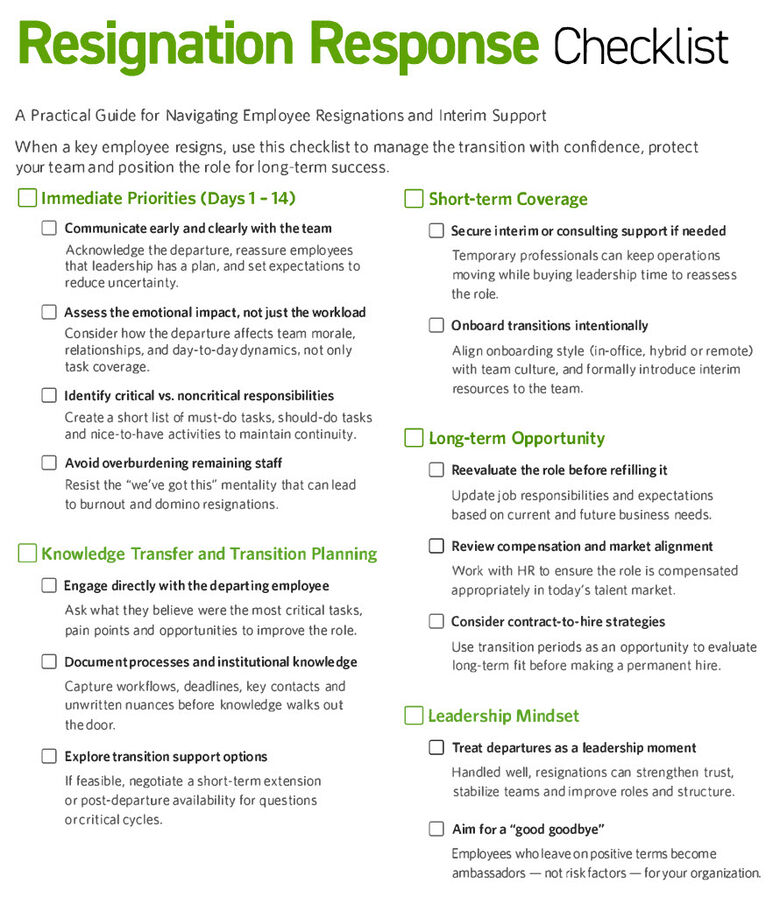
Your Guide Forward
Unexpected resignations don’t have to derail your team. Cherry Bekaert’s Recruiting & Staffing Services help organizations during transitions by providing interim professionals, contract‑to‑hire solutions, and strategic hiring guidance when continuity and timing matter most.
Related Insights
See how organizations responded when key accounting professionals resigned — and how interim support, thoughtful role redesign, and strategic hiring helped protect teams and operations.
- Case Study: From Vision to Reality: How Insightful Questions Led to a Key Finance Hire
- Case Study: Advisory‑led Recruiting Approach Delivers Financial Stability for Growing Consumer Goods Company
- Case Study: Meeting Controllership‑level Needs for a Large Supplier Through Advisory and Resource Solutions