

If you were to ask 10 executives who’s responsible for artificial intelligence (AI) risk at their company, you'll likely hear 10 different — and often contradictory — answers, and at least one that starts with "it's complicated." In many organizations, responsibility is not clearly defined, and that ambiguity has become a liability. The AI triad solves this ownership question by providing a structured group with defined responsibilities.
With regulatory frameworks hardening and internal risks, such as data leakage and supply chain exposure compounding, it is clear AI ownership needs to be implemented. To effectively utilize the AI triad, companies must establish accountability and make a few foundational changes to support their AI systems.
AI Risk Owners: The Options
AI deployments are increasingly being approved by non-development teams, quickly reviewed by legal, potentially flagged for security reasons, and quickly signed off and implemented. This raises the vital need for defined AI risk ownership. However, many executives have a claim to manage AI risk, and the overlap is the precise reason it is so difficult to establish accountability.
Chief Executive Officer (CEO)
CEOs own business outcomes, not their day-to-day operations. So, to assign responsibility for issues like governing prompt injections or AI jailbreaking attacks would be unreasonable. That kind of accountability is not practical at the CEO level.
Chief Information Security Officer (CISO)
CISOs bring expertise in modeling threat scenarios, privacy and data security, but AI risk extends well beyond traditional security considerations. Model bias, fairness, regulatory compliance, and third-party risk don’t fit into the typical definition of information security.
Chief AI Officer (CAIO)
The CAIO is the closest match in AI oversight. However, according to IBM, only 26% of organizations have them, and many in this role are focused on pushing adoption and speed while neglecting security. It is crucial to ensure governance by slowing adoption down and being precise. A CAIO must be comfortable saying “no” when necessary.
Legal
Legal teams are critical for the contractual and regulatory side of AI adoption, but they’re built to be responsive to issues rather than continuously managing operational AI risk. Waiting for legal to solve an AI problem would be like patching a defect in production after a product has already been shipped to every user.
Chief Compliance Officer (CCO)
The chief compliance officer (CCO) is critical for translating regulatory requirements into governance and maintaining audit readiness. But AI risk moves faster and broader than compliance alone — spanning operational and technical decisions that require more continuous, cross-functional oversight.
The Answer: AI Triad
Having defined what each role is and is not responsible for, organizations should be concluding the same answer: no single role can fully own AI risk, but a structured group with clearly defined responsibilities with one single point of final accountability can.
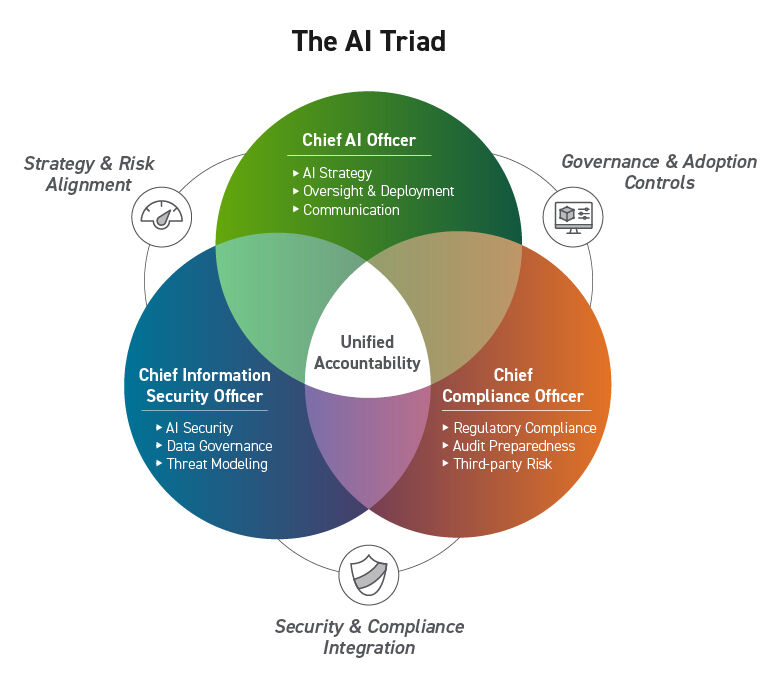
Similar to how security professionals reference the CIA triad (confidentiality, integrity and availability) organizations can use the AI triad, which is the governance equivalent for the adoption of AI. In this model:
- CAIO owns AI strategy, oversight, deployment and communication responsibilities
- CISO owns the AI security, data governance and threat modeling
- CCO owns regulatory and compliance mapping, audit preparedness and third-party risk
Together, these three functions form the triad. The CEO remains the final escalation point and the public face of accountability, but delegates operational authority to the triad.

What Happens Without a Chief AI Officer
While 66% of organizations are expected to hire a CAIO within the next two years, many organizations are deploying AI at scale today without one or any equivalent role. As a result, solutions are built, but not all of them are safe or governed consistently. By the time the problems are visible, they're expensive to fix. Hiring a CAIO is an increasingly immediate priority for many — and should be.
During Cherry Bekaert’s inaugural Technology Summit, Risk Advisory Services Partner Matisse Long compared this scenario to “trucks full of shipments, driving without any traffic lights or rules of the road.”
Without a dedicated leader monitoring the whole AI development and plan, organizations face fragmented accountability and decision-making ambiguity. Boards and stakeholders are increasingly asking questions about AI:
- What AI systems are we using?
- What are the risks?
- How much is being spent?
If the answer requires gathering four executives who each own a piece of the risk, it can reduce the board confidence.
What Needs To Change for the AI Triad To Work
The AI triad provides a strong foundation, but structure alone won't lead a company to success. Three main things need to change first.
1. The CAIO Role Must Be Developed and Redefined
The CAIO must have clear authority to manage risk with the ability to say no, at the cost of AI adoption. The CAIO needs to understand the risks that come with poor AI governance.
2. Give the Board Skin in the Game
AI risk is now a measurable business risk. Boards that leave AI oversight to management are taking on more risk that they may not have intended on. Every board needs members with sufficient AI literacy who can contribute.
3. Normalize Taking Time
The ability to stop, roll back or restart an AI system is essential. If this happens, it should not be treated as a failure, but as progress. There's no need to push an imperfect system with the sole purpose of quick adoption if it brings along security risks.
How AI Risk Ownership and Governance Transforms Ambiguity to Accountability
Governance has always lost the race against technology. However, with AI, the gap is increasing faster than ever. The longer organizations operate without clear ownership of AI risk, the greater the exposure to financial, operational and reputational consequences.
The solution is not more discussion, it’s decisive structure. Establishing an AI triad with defined roles and a single point of accountability transforms fragmented oversight into coordinated governance. It enables organizations to move forward with confidence, not uncertainty.
Organizations that act now will be better positioned to scale AI securely, respond to regulatory pressure and maintain stakeholder trust.
Your Guide Forward
If your organization is still navigating AI risk ownership or needs support assessing AI-related risks, Cherry Bekaert’s AI Security Services team can help. Connect with us to evaluate your current posture, define clear accountability, and build a governance model that keeps pace with innovation.