


As interest rates rise and liquidity tightens, organizations face pressure to manage cash at a more granular level, making the 13-week cash flow forecast model an increasingly valuable leadership discipline.
Typically reserved for crisis scenarios, the 13-week cash flow model offers organizations a structured, forward-looking approach to managing liquidity, which is particularly relevant for private equity (PE) firms and their portfolio companies. Instead of deploying capital to fuel growth, businesses in today’s market may find themselves allocating cash toward interest payments or maintaining excess liquidity buffers simply to sustain inefficient operations.
Proactively implementing this direct cash flow model, rather than waiting until the business is already in distress, may prevent future liquidity crunches or allow leaders to more quickly understand the levers to improve cash if the business does face restructuring or bankruptcy.
Key Insights
- The 13-week cash flow model has historically been reserved for crisis situations.
- Using the model before the business is in distress can help avoid liquidity crunches.
- The 13-week forecast model is a direct cash flow model that offers forward-looking estimates.
- This model is particularly beneficial for PE firms and their portfolio companies, as it can boost visibility into capital management, improve debt servicing confidence and more.
- Collaborating with trusted advisors provides a tailored approach to implementing 13-week cash flow forecast models and creating sustainable processes for maintaining forecasts.
What Is a 13-week Cash Flow Model?
A 13-week cash flow model is a short-term, rolling forecast that provides a weekly view of expected cash inflows and outflows over a 13-week horizon. Unlike traditional financial reporting, which is often retrospective and periodic, this model delivers near real-time visibility into cash movements.
At its core, the forecast model operates as a direct cash flow forecast, meaning it tracks actual receipts and disbursements, including what cash is coming in and going out, on a weekly basis.
This allows organizations to:
- Estimate their near-term liquidity position
- Identify timing gaps between inflows and obligations
- Understand the operational drivers of cash performance
- Ensure sufficient cash to meet debt obligations
Importantly, the 13-week cash flow is not intended to be an audited financial statement. Rather, it is a practical, decision-making tool designed to help proactively manage liquidity.
Indirect vs. Direct Cash Flow
Most organizations are familiar with the indirect cash flow statement, which is derived from financial reporting. However, the 13-week model takes a fundamentally different approach.
| Indirect Cash Flow | Direct Cash Flow |
|
Begins with net income |
Starts with cash receipts and moves through operating and non-operating disbursements |
|
Adjusts for non-cash items and balance sheet changes |
Tracks real cash movement |
|
Prepared monthly or quarterly |
Updated weekly |
|
Provides a retrospective view |
Provides more granular retrospective view and forward-looking insights |
|
Requires a formal close process |
Offers visibility without requiring monthly close |
The indirect cash flow model begins with net income and adjusts for non-cash items and changes in the balance sheet to arrive at cash flow. It is typically prepared on a monthly or quarterly basis and serves as a backward-looking view of financial performance. Because it relies on the completion of the financial close process, including adjustments and reconciliations, insights may be delayed by days or even weeks after the reporting period ends.
By contrast, the 13-week cash flow model follows a direct method that starts with expected cash receipts and disbursements and tracks actual cash movements in and out of the business. Updated on a weekly basis, the model provides a forward-looking, actionable view of liquidity. Additionally, it does not require a formal close process to generate meaningful insights, which allows leadership teams to access timely information and make decisions with greater speed and confidence.
While indirect models explain what has already occurred, the 13-week cash flow model equips organizations to anticipate what lies ahead and act accordingly.
13-week Cash Flow Forecast Model Structure
The 13-week cash flow forecast model gives leaders a week-by-week view of expected liquidity, helping them understand how much cash the business is likely to have on hand in the weeks ahead. The model tracks anticipated cash receipts and disbursements, calculates weekly net cash flow and projects ending cash balances across a 13-week horizon.

Using the 13-week Cash Flow Forecast Model as a Leadership Discipline
Historically, 13-week cash flow models have been associated with distress scenarios, such as restructurings, liquidity crunches or meeting lender-driven requirements. When using this model during a crisis, options may be more limited, and implementation becomes reactive.
However, organizations that adopt this model proactively gain a distinct advantage. When implemented as an ongoing discipline rather than a reactive measure, it enables leaders to:
- Identify cash flow risks early
- Quickly pull operational levers to improve liquidity
- Avoid the “fire drill” of standing up a model during a crisis
The shift is subtle but powerful, as finance teams move from managing profitability alone to managing both profitability and liquidity in tandem.
Strong profit and loss (P&L) performance does not guarantee healthy cash flow. Without deliberate attention, companies may require additional funding to bridge timing gaps, which ultimately increases interest expense and erodes value.
A Strategic Imperative for Sponsors and Operators
For PE-backed companies, managing cash effectively is a core driver of performance. By adopting the 13-week cash flow model as a leadership discipline, portfolio companies can move beyond simply managing profitability to optimizing cash conversion, capital efficiency and balance sheet performance. In today’s higher-cost capital environment, those capabilities are essential to protecting and growing enterprise value.
9 Steps To Build a 13-week Cash Flow Forecast Model
A 13-week cash flow forecast provides a rolling view of expected cash inflows and outflows. Organizations can build one by following the steps below.
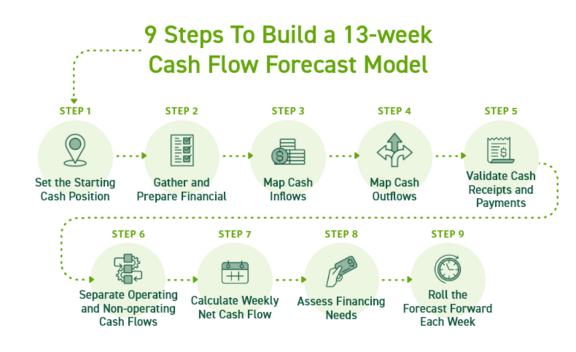
1. Set the Starting Cash Position
Begin with cleared cash balances across all active bank accounts, rather than book balances. Then, establish 13 weekly columns with defined start and end dates.
2. Gather and Prepare Financial Data
Pull weekly cash-based data from accounts receivable (AR), accounts payable (AP), payroll, capital expenditure plans, and other known cash commitments. Reconcile the cash account and adjust accrual-based figures to reflect when cash is actually received or paid.
3. Map Cash Inflows
Identify expected cash receipts and assign them to the week they are expected to clear. Use AR aging reports to estimate customer collections and include other receipts such as recurring revenue, loan proceeds and planned asset sales.
4. Map Cash Outflows
Schedule expected cash disbursements based on actual payment dates. Include accounts of AP, payroll, rent, taxes, insurance, debt, capital expenditures (CapEx), prepaid expenses and other operating obligations.
5. Validate Cash Receipts and Payments
Review the timing and amount of forecasted cash receipts and disbursements to verify they reflect real collection patterns and payment terms. This step works to validate assumptions before calculating weekly cash flow projections.
6. Separate Operating and Non-operating Cash Flows
Distinguish cash generated or spent through normal operations from financing and other non-operating activities. Include items such as interest, fees, debt payments, and other financing-related cash flows.
7. Calculate Weekly Net Cash Flow
Subtract total weekly cash outflows from total cash inflows to determine net cash flow for each week. Add net cash flow to the beginning cash balance to calculate the ending cash position.
8. Assess Financing Needs
Review projected ending cash balances to identify potential cash shortfalls. Determine whether the organization needs additional financing or whether existing credit facilities and other sources of liquidity can cover the gap.
9. Roll the Forecast Forward Each Week
Compare forecasted cash flows with actual results and investigate significant variances. Remove the completed week, add a new week, and update the forecast using the latest collections, payments and financial information.
Key Benefits of a 13-week Cash Flow Model
When integrated into regular operating cadence, this model delivers meaningful value across the organization, such as improved visibility and enhanced working capital management. For PE-backed companies, it creates benefits for both the portfolio company and sponsor.
Improved Liquidity Visibility
A weekly forecast provides real-time insight into cash positioning, enabling faster, more informed decisions.
Enhanced Working Capital Management
By highlighting the timing of receivables and payables, organizations can use a 13-week cash flow to identify opportunities to improve collections, optimize payment timing, and strengthen working capital efficiency.
With improved visibility, sponsors can identify excess cash or shortfalls earlier, and make informed decisions around reinvestment, distributions or additional funding needs.
Greater Confidence in Debt Servicing
Leveraged companies gain clarity about their ability to meet interest and principal payments, which reduces uncertainty for both management and stakeholders.
Alignment Between P&L and Cash Performance
The model highlights the disconnect between reported profitability and actual cash generation, enabling more balanced decision-making.
Stronger Stakeholder Communication
Whether engaging lenders, investors or boards, a 13-week cash flow offers a transparent and credible view of near-term liquidity.
Stronger Governance and Reporting
The model supports more transparent and consistent communication with lenders, boards and investment committees. This transparency is an increasingly important consideration in today’s environment.
Common Mistakes to Avoid When Using the Forecast Model
One of the main mistakes companies make when implementing the 13-week cash flow is treating it like an audited financial statement, or specific performance metric, rather than a tool to manage liquidity. Because of this, organizations may hesitate to adopt the model out of fear of producing statements that are estimates or approximate measures of cash.
On the other hand, some teams may rely on this forward-looking data without incorporating historical cash flow patterns — context that is needed for credible, grounded forecasts. Additionally, highly complex or pre-packaged models can be difficult to maintain and adopt across the organization.
Turning Insight into Action With the 13-week Cash Flow Forecast Model
Cash is often the resource that gives management teams the most flexibility, while leaving the least room for error. Organizations that use the 13-week cash flow model as more than a tactical tool are better prepared to deal with economic uncertainty, optimize capital allocation decisions, and support long-term value. The question is no longer whether companies should adopt this model, but how quickly they can integrate it into their day-to-day operations.
Utilizing Trusted Advisors During Implementation
Implementing a 13-week cash flow model is not a one-size-fits-all exercise. Success depends on aligning the model with the organization’s operations, systems and processes. Cherry Bekaert’s CFO Advisory Services professionals take a hands-on, customized approach to implementation. We work closely with finance and accounting teams to:
- Understand current treasury, accounts payable (AP) and accounts receivable (AR) processes
- Identify key cash drivers and operational nuances
- Design a model tailored to the organization’s structure and systems
- Build sustainable, repeatable processes for maintaining the forecast
- Train finance teams to interpret and act on insights
Our team also collaborates with CFOs and finance organizations to establish forecasting methodologies and integrate the model into regular reporting and decision-making processes. This approach provides companies with an embedded capability, one that supports value creation across the investment lifecycle.
Reach out to an advisor today to learn more about our 13-week cash flow solutions.