


The Financial Industry Regulatory Authority (FINRA) has adopted amendments to Rule 4210 that replace the legacy pattern day trader (PDT) framework with a modern intraday margin standard. FINRA’s intraday margin requirements took effect on June 4, 2026, with an implementation phase-in period permitted through October 20, 2027.
For fund managers executing active strategies through broker-dealer margin relationships, the change can make intraday leverage a more dynamic operational variable. Because broker-dealers may implement the standard through real-time trade blocking and/or end-of-day deficit calculations, workflows may need to account for differing monitoring intensity across counterparties.
At-a-Glance: What Changed and What Did Not
What Changed
The pattern day trader regime and associated concepts are removed from Rule 4210, including the $25,000 minimum equity threshold tied to the legacy PDT framework.
Broker-dealers must identify and manage intraday margin deficits in customer margin accounts using real-time trade blocking and/or end-of-day deficit calculations with calls.
What Remained the Same
This is not a wholesale rewrite of margin requirements. Firms may continue to apply house requirements above regulatory minimums depending on product type, concentration, volatility and internal risk appetite.
Why Take Notice
During the phase-in period (June 2026 – October 2027), broker-dealer implementation strategies will diverge. This non-uniformity creates a fragmented regulatory environment where the same strategy may face different intraday constraints depending on the counterparty.
How the New Standard Can Show Up in Day-to-Day Operations
Many funds, particularly emerging managers, operate across a mix of relationships, including prime brokerage, multiple executing brokers and/or platform-based margin access. Because the intraday margin standard is implemented at the broker-dealer level, managers should expect the “how” and “when” of constraints to vary by counterparty. With this in mind, two operational dynamics may emerge in daily operations.

1. Intraday Capacity May Tighten Faster Than End-of-Day Workflows
If a broker uses real-time monitoring to prevent deficits, a trading desk may encounter hard stops, or trade blocks, that require rapid coordination between trading, operations and treasury functions. If a broker uses end-of-day calculations, constraints may surface as a call and remediation timeline, still requiring disciplined processes to avoid recurring events.
2. Deficit Response Discipline Can Affect Trading Activity Continuity
The framework centers on identifying intraday margin deficits and expecting customers to satisfy them as promptly as possible. Repeated failure to satisfy deficits promptly may result in account restrictions for up to 90 days, depending on facts, patterns and firm policies. For active strategies, the risk is often less about a single deficit event and more about repeated remediation cycles during fast markets.
Practical Questions for Fund Managers To Review
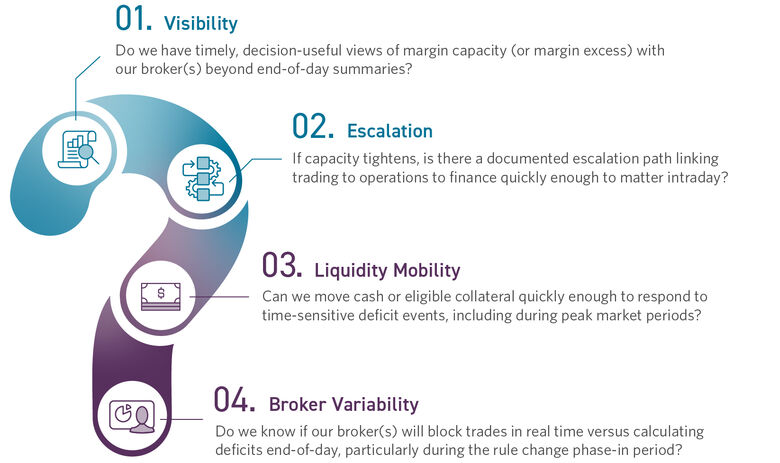
In practice, readiness often comes down to a small set of questions:
Planning for a Non-uniform Rollout
Even with a firm effective date of June 4, 2026, the phase-in window through October 20, 2027, is designed to give broker-dealers time to integrate real-time surveillance and controls. For fund managers, this reinforces readiness as partly internal and partly counterparty specific. Mapping different brokers’ approaches and capabilities is often as important as updating your own internal policies and procedures.
Operational Implications and Next Steps
FINRA’s intraday margin standard modernizes how broker-dealers supervise intraday margin risk, placing a premium on intraday visibility, escalation discipline and liquidity mobility. Fund managers who address these operational dependencies early are better positioned to reduce unplanned trading constraints and avoid recurring deficit remediation cycles during volatile markets.
Cherry Bekaert’s Asset Management team supports established and emerging managers with operational readiness and support, spanning policy and internal control design, process documentation and reporting considerations that often sit alongside active trading strategies. If you are assessing how your broker’s intraday monitoring approach may affect execution workflows, we can help you identify practical readiness priorities.
Contact our Audit and Tax Advisors today to discuss your intraday margin infrastructure and operational readiness.
This article is for informational purposes only and does not constitute legal, tax or investment advice.