Across the alternatives landscape, select asset classes delivered year-end performance not seen in decades, with precious metals rewriting record books and hedge funds posting their best collective year since the aftermath of the global financial crisis. Meanwhile, broader commodities staged a remarkable resurgence, even as crude oil moved in the opposite direction. With these combined factors, 2025 stands as a defining year for the case in favor of portfolio diversification through alternatives.
For fund managers and advisors, 2026 is proving more unstable and less predictable. Perhaps the most important takeaway for portfolio managers is the failure of traditional correlations. In a world where equities, bonds, and even cryptocurrencies moved together during stress events, gold and select hedge fund strategies delivered genuine diversification.
The 2025 – 2026 period is becoming a case study in why alternatives deserve a permanent, not tactical, seat at the portfolio construction table.
In this Alternative Investments Brief we take a closer look at some of the records set in 2025 and dive deeper into the factors that fueled early year performance in Q1 2026.
Asset Class Updates
Commodities
Precious metals saw a historic year in 2025 with the price of gold soaring, delivering one of its best performance years ever with annual gains over 65% and closing the year at around $4,325 per ounce. The dramatic rise was driven by several key factors, including:
- Ongoing conflicts and global instability, which boosted demand for safe-haven assets.
- Emerging market central banks continued robust buying to diversify reserves away from the U.S. dollar.
- A depreciating U.S. dollar makes dollar-denominated gold cheaper for holders of other currencies.
Shining even brighter was silver, the best-performing major commodity of 2025, with an increase upwards of 150% for the year. The metal repeatedly broke price records, reaching the $50 per ounce mark in October and breaking through to $70 per ounce, a record high to end the year.
Precious Metals Historical Prices ($US/oz)
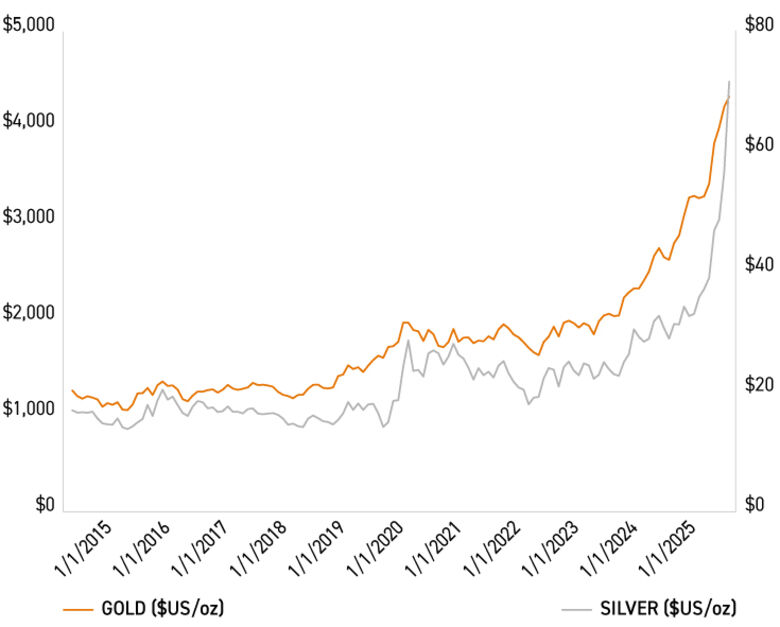
More recently, gold reached a 52-week high of $5,318.40 on January 29, 2026, but has pulled back to around $4,678 per ounce through March. Silver realized a similar peak in January and has now settled back down to prices of around $75 per ounce through mid-April. The cooling off in January was primarily a product of investors selling positions in precious metals, taking the opportunity to realize profits amid record highs.
Crude oil hit a nearly five-year low in December 2025 at $54.98 per barrel and closed the year at $57.42. Two primary drivers of the new lows seen in 2025 were production levels and supply demand. U.S. crude oil production reached a new record high with a production level of 13.5 million barrels per day, while tariff announcements and a decline in overall market demand caused supply levels to swell and prices to drop even further.
Crude Oil Historical Prices ($US/Barrel)
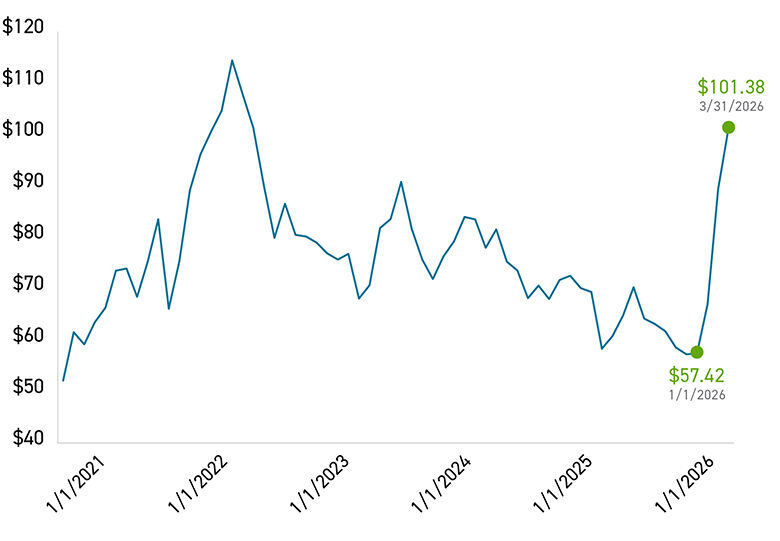
Recent geopolitical events, primarily the U.S. and Israel’s joint campaign against Iran that began in late February, has sent the barrel price of crude soaring back up to over $100 per barrel, closing the month of March at $101.38. The Strait of Hormuz, the maritime byway that usually sees approximately 20% of the world’s oil and liquid natural gas transported through, has now been virtually shut down and at a standstill since March.
In late March, U.S. President Donald Trump indicated that the current military campaign might wind down within weeks. However, the Strait of Hormuz was closed again by Iran in mid-April, and as of April 23, an extended ceasefire was in place with the U.S. prepared to fire upon any Iranian vessels found planting mines. Major economists indicate this is the largest oil supply disruption in the history of the global oil market.

Hedge Funds
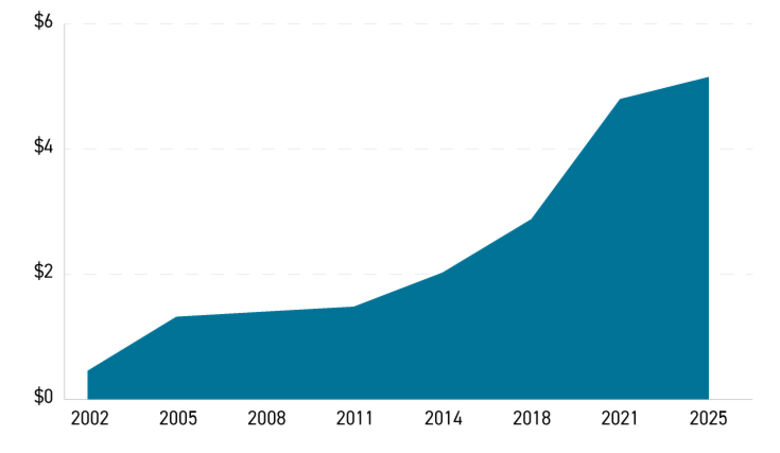
Hedge funds also made headlines in 2025, reaching a new historic capital threshold. Cumulative global hedge fund assets under management (AUM) climbed by $642.8 billion last year, marking the strongest year of inflows since 2007 and the global financial crisis, emphasizing a solid revitalization of the asset class in the marketplace.
Hedge funds have forged through challenges over the past decade, including increased regulation and market volatility, to become an asset allocation now considered essential to modern portfolio diversification. The latest reporting data from Hedge Fund Research, released Q4 2025, reports total global AUM for hedge funds was $5.15 trillion.
Total Global AUM in Hedge Funds ($US Trillions)
At the start of 2026 , hedge funds were moving in a positive direction, building on the momentum of strong gains in 2025. Amid continued market volatility and increasing dispersion, and most recently the U.S. involvement in Iran and the trickling economic effects, hedge funds struggled through the end of the first quarter. However, some strategies have shown positive gains thus far, including macro strategies and commodities. The HFRI 500 Macro: Commodity Index saw over 15% returns through March and it was the only index on the HFRI 500 indices to realize a double-digit increase in Q1 2026.
Digital Assets
Reaching an aggregate market cap of a record $311 billion in 2025 and realizing roughly 50% growth year over year, stablecoin has been a clear standout amongst cryptocurrency and digital assets in recent months.
Stablecoin Supply by Issuer ($US Billions)
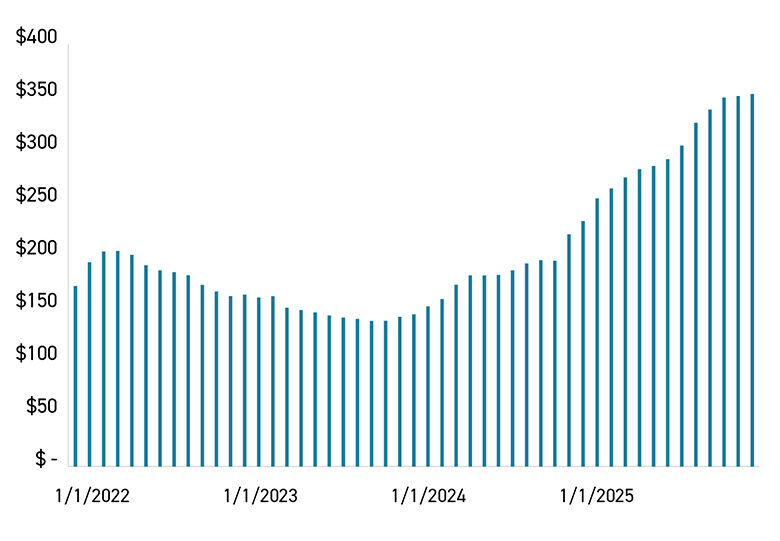
The intense growth observed in 2025 was heavily bolstered by the signing of the Guiding and Establishing National Innovation for U.S. Stablecoins (GENIUS) Act on July 18, 2025. This is the first major federal stablecoin law enacted in the U.S. and establishes the early formal regulatory framework for digital currency.
GENIUS also enables direct oversight from the Federal Reserve and the Office of the Comptroller of the Currency (OCC). Following this is the Digital Asset Market Clarity Act (CLARITY), which is focused on establishing a new regulatory framework for digital asset markets and is currently progressing to the Senate.
Stablecoins are now the seventeenth-largest holder worldwide of U.S. Treasuries with over $150 billion. The year-end surge also means that more than 1% of all U.S. dollars now exist as tokenized stablecoins on public blockchains. The shifts seen in 2025, and the current legislation underway, point to the compelling fact that digital assets are transitioning from an experimental asset into an impactful class of modern alternatives.
Markets in Motion
The changes experienced from 2025 to 2026 fundamentally shifted the baseline for institutional strategy, moving into a new era of structural realignment. As artificial intelligence evolves into the implementation phase of operational results, its success is becoming a critical filter for market leadership. This technological pivot, paired with high volatility and impactful geopolitical events, has created a landscape where traditional equity benchmarks are no longer the sole arbiters of performance.
The record-shattering milestones in gold, silver, and hedge fund inflows are not merely outliers, but clear indicators that the modern portfolio is being rebuilt around specialized alpha and defensive resilience.
Moving forward, the ability of managers to maintain operational integrity in the face of ongoing supply chain disruptions and geopolitical shifts will be paramount. Investors and fund managers alike should remain vigilant and closely monitor how macro pressures further influence commodity volatility, as well as the continued institutionalization of alternative asset classes.