In response to the talent shortage created by the declining number of certified public accountants (CPAs), many corporate finance departments are relying on professional services firms to fill the gaps. This disruption has created demand for different service offerings to assist impacted organizations, prompting their leaders to ask the questions, “What does this mean for my company, and how do I determine what I need?” The answers to these questions center around the strengths and limitations of the organization’s current accounting team.
Learn more about what co-sourcing is and its benefits to better assess if it’s the right solution for your organization.
Co-Source Key Takeaways
- Co-sourcing combines internal accounting teams with external specialists to fill capability and capacity gaps.
- This option helps organizations access technical accounting support without replacing their in-house team.
- Co-sourced subject matter experts can assist with complex projects such as IPO readiness, ERP implementation and audit preparation.
- The co-sourced model offers flexibility, scalability and cost efficiency for specific projects or specialized needs.
What Is Co-sourcing?
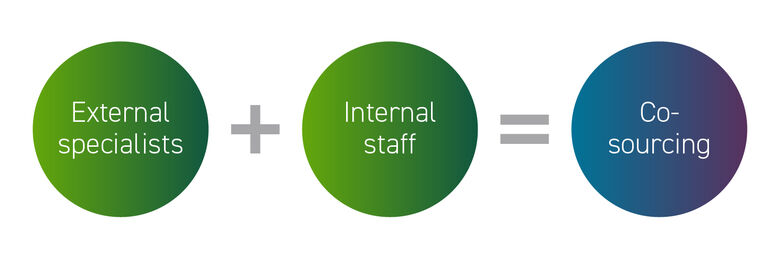
Co-sourcing is the practice of combining internal staff with external support. In-house specialists work with a third-party vendor to help fill specific resourcing gaps and increase productivity for the business.
How Does the Co-sourcing Accounting Model Work?
Co-sourced accounting, sometimes called co-outsourced accounting or bookkeeping, has become more popular in recent years as a flexible and collaborative solution. It is a tactical approach for organizations that have quality team members to “keep the lights on” but also needs additional accounting knowledge.
Historically, a traditional outsourced accounting or loan-staff model meant clients were assigned a single team that might not have a wide breadth of skills to satisfy all of the business’s requirements. These specialists used their own workflows and software to manage the client’s day-to-day operations but did not have the ability to help with more technical demands.
However, today’s co-sourcing is carried out by multiple subject matter experts (SMEs) throughout various phases, depending on the nature of the matter. Co-sourced SMEs do not replace the in-house team but simply supplements their capabilities and capacity. This gives the business more flexibility and resources to accommodate larger projects.
For example:
A company needs technical accounting advisory to help its internal accounting team navigate complex requirements of preparing its financial statements for the Public Company Accounting Oversight Board (PCAOB) for an initial public offering (IPO).
An accounting department selects a new ERP or needs to implement new technology. Co-sourced specialists can help expand the company’s bench strength or alleviate capacity constraints so that key team members can prioritize projects accordingly.
In each of these cases, the company may not have the in-house expertise, limited capacity to address the issue, or inconsistent transaction volume to justify hiring an additional full-time equivalent (FTE).
Co-sourcing vs. Outsourcing
When considering these two alternatives, look for these key indicators:
|
Definition |
Key Indicators for |
|
|
Co-sourcing |
Using an external provider to supplement your internal accounting function | Your organization has an accounting team with most of the competencies needed, reasonable industry/business understanding, and/or a serviceable enterprise resource planning (ERP) platform, but you need help filling the gaps. |
|
Outsourcing |
An external provider takes full ownership of accounting or specific tasks | Your organization needs day-to-day accountants to cover the basics (i.e., billing, collections, procurement, accounts payable, payroll general ledger). You could also move toward the ERP tool an outsourcing team uses and replace most, if not all, of your team and not lose ground. |

Benefits of Accounting Co-sourcing
The current economic climate and regulatory environment are challenging for corporate accounting departments and leave little room for error. All eyes are on the finance function, with agencies like the Securities and Exchange Commission and the PCAOB increasing their level of scrutiny. Audit firms are simultaneously trying to minimize risk exposure by lowering materiality thresholds. Additionally, the post-pandemic era has led many companies to seek creative financing — convertible debt, warrants, equity-based compensation, among others — that trigger complicated accounting. In this complex and demanding environment, co-sourced accounting can provide numerous benefits, including:
- Flexibility and Scalability: Businesses can quickly adjust the amount of support they receive from the service provider based on their current needs.
- Specialized Experience: Co-sourced SMEs can assist with complex situations like technical accounting, risk management or IPOs.
- Maintained Control: Final decisions are made by the in-house team and carried out by the external specialists.
- Reduced Costs: Organizations can avoid investing in full-time positions for one-off projects, reducing the need for recruiting and training.
- Improved Risk Management: Co-sourced specialists can help standardize accounting processes and documentation, helping the internal team improve audit readiness.
Co-sourced Frequently Asked Questions
Co-sourcing supplements an existing accounting team with external support, while outsourcing shifts full ownership of certain accounting functions to an external provider. The key difference is whether the outside provider supports the internal team or takes over the work entirely.
Co-sourcing can require additional coordination between internal and external team members, and outside specialists may need time to understand the organization’s systems, processes and business context. Costs can also increase if the scope, timeline or level of support is not clearly defined.
Co-sourcing is often the better fit for internal audit functions because it allows the organization to retain oversight while bringing in specialized support for risk, compliance or technical needs. Although, outsourcing may be more appropriate when the company wants an external provider to fully manage the internal audit function.
Companies should consider co-sourced accounting when they have a capable internal team but need additional capacity or specialized knowledge for complex projects, technical accounting needs, system implementations or audit readiness. It can be especially useful when the need is temporary or does not justify hiring a full-time employee.
How Cherry Bekaert Can Help
If you’re looking for a strategic advisor to boost and broaden your current team’s capabilities, co-sourced accounting could be the answer for your accounting department. Cherry Bekaert’s co-souring solutions provide the capacity and capability to support in-house teams and can assist your organization at the level it needs. Our practice is equipped with the experience and knowledge to help your accounting function fill the gaps and deliver value.
Related Insights
- Article: Capacity Plus Capability: How Co-Sourcing Can Help Overcome the CPA Shortage and Restore Confidence
- Article: Evaluating the Current State of Accounting Departments in the Middle Market & How to Position for the Future
- Article: Outsourced Accounting and CFO Services: The New Finance Operations Model