


Organizations impacted by California’s climate disclosure laws need to quickly gain a firm understanding of their legal reporting requirements to achieve compliance in this jurisdiction. These regulations require companies to measure and report greenhouse gas (GHG) emissions with increasing transparency, providing stakeholders — including customers, investors and regulators — a clearer view of environmental impact and contributing to a more sustainable and resilient future.
This requirement is already affecting day-to-day business operations. Customers are requesting emissions data now, driven by their own reporting obligations under SB 253 and other emerging frameworks. As a result, emissions reporting extends beyond companies directly in scope and into the broader value chain.
Companies subject to SB 253 must report Scope 1 and Scope 2 emissions beginning with the November 10, 2026 deadline — an extension from the previous August 10, 2026, deadline — with Scope 3 reporting to follow. Because Scope 3 includes supply chain activity, these organizations are requesting emissions data from suppliers to meet their own obligations.
For suppliers, this creates a new expectation: The ability to provide credible emissions data is becoming necessary to maintain existing relationships and compete for new business.
The National Landscape: California Sets the Pace
Mandatory climate disclosure is becoming an increasingly important part of the regulatory landscape. While jurisdictions around the world continue to develop climate reporting requirements, California has established the broadest mandatory climate disclosure framework in the U.S.
The U.S. Securities and Exchange Commission (SEC) also adopted federal climate disclosure rules in 2024, but implementation was stayed pending legal challenges. On May 29, 2026, the SEC proposed rescinding the rules in their entirety, with a public comment period open through August 3, 2026. Until any final action is taken, the federal rules remain non-operative, leaving California's climate disclosure laws as the primary reporting framework for many U.S. companies.
Several states, including New York and New Jersey, are advancing legislation modeled after California's framework. As a result, organizations operating across multiple states may find that preparing for California's requirements establishes the foundation for compliance with future state-level regulations.
Beyond direct regulatory obligations, California's disclosure requirements are also influencing customer expectations. Companies subject to SB 253 are increasingly requesting greenhouse gas emissions data from suppliers to support their own reporting obligations, extending the impact of these regulations well beyond organizations that are directly in scope.
For many organizations, developing a scalable, defensible greenhouse gas reporting process today not only supports compliance with California's requirements but also positions them to respond efficiently to evolving regulatory, customer and investor expectations.
Join Us at Our Upcoming Manufacturing Summits
Join Cherry Bekaert and industry leaders for timely discussions on the trends, challenges, and opportunities shaping today's manufacturing environment. These regional summits bring together manufacturing executives and business leaders to explore strategies for driving operational efficiency, embracing innovation, navigating economic change and positioning their organizations for sustainable growth.
- Reading, PA
Tuesday, October 20 | 3:30 – 6:30 P.M - Cincinnati, OH
Tuesday, October 27 | 8:00 – 11:30 A.M. - Louisville, KY
Thursday, October 29 | 7:45 – 10:30 A.M
California’s Climate Disclosure Laws: A Closer Look
In October 2023, Governor Gavin Newsom signed two significant pieces of climate legislation that together created the broadest mandatory climate disclosure regime in the U.S. and have substantial implications for certain businesses operating in California.
- Senate Bill 253 (SB 253), also known as the Climate Corporate Data Accountability Act, requires entities doing business in California with annual global revenue above $1 billion to disclose their Scope 1, 2 and 3 greenhouse gas (GHG) emissions.
- Senate Bill 261 (SB 261), which focuses on climate-related financial risk reporting, requires entities doing business in California with annual global revenue above $500 million to publish a biennial climate-related financial risk report using the Task Force on Climate-Related Financial Disclosures (TCFD) framework or an equivalent framework, such as the International Sustainability Standards Board (ISSB) standards.
A 2024 clean-up bill, SB 219, gave the California Air Resources Board (CARB) additional flexibility on timing and confirmed that affiliated reporting at the parent level satisfies subsidiaries' obligations.
These regulations mandate that companies accurately measure and report their greenhouse gas emissions so that stakeholders, including investors, consumers and the general public, can better understand a company’s environmental impact.
Impacted organizations will need to identify and measure direct and indirect greenhouse gas emissions associated with their operations, including emissions from Scopes 1, 2 and 3, covering everything from on-site fuel combustion to supply chain activities. Below, in Exhibit 1, we outline the key requirements for both SB 253 and SB 261. Exhibit 2 takes a closer look at the definitions of these three different scopes.
Exhibit 1: Key Attributes of the California Climate Disclosure Laws
| SB 253 — Climate Corporate Data Accountability Act | SB 261 — Climate-Related Financial Risk Act | |
| Primary disclosure | Scope 1, 2 and 3 GHG emissions required | Climate-related financial risks and the measures adopted to mitigate and adapt to those risks |
| Framework | GHG protocol | TCFD framework transitioned to ISSB standards (or equivalent) |
| Who is affected | Entities doing business in California with annual global revenue above $1 billion | Entities doing business in California with annual global revenue above $500 million |
| Exemptions | Limited; affiliated reporting at parent level permitted | Certain insurance companies |
| Location for filing | Publicly available digital platform administered by CARB | Posted publicly on company's website |
| Assurance | Limited assurance on Scopes 1 and 2 beginning with 2027 reporting; reasonable assurance phased in later | Not required |
| Measurement dates | Began January 1, 2025, for Scopes 1 and 2; and January 1, 2026, for Scope 3 | Began January 1, 2025 for Scopes 1 and 2 |
| First report due | August 10, 2026 (Scopes 1 and 2); Scope 3 begins in 2027 | Originally January 1, 2026; enforcement currently paused by Ninth Circuit injunction |
Exhibit 2: Classifications of Emissions Defined
| Scope | Definition |
| Scope 1 | Direct emissions from sources a company owns or controls — for example, fuel combusted in company vehicles, on-site boilers or owned manufacturing equipment. |
| Scope 2 | Indirect emissions from purchased energy, typically electricity, steam, heating or cooling supplied by a utility. Indirect but readily measurable. |
| Scope 3 | All other indirect emissions across the upstream and downstream value chain — purchased goods and services, business travel, transportation, product use and end-of-life disposal. Scope 3 typically accounts for 70% – 90% of total emissions and is the most complex to quantify. |

Where Things Stand in 2026 and What Comes Next
Years following the signing of SB 253 and SB 261, the compliance window is no longer theoretical.
In June 2026, CARB announced plans to extend the initial SB 253 reporting deadline for Scope 1 and Scope 2 emissions by three months — from August 10 to November 10, 2026 — to provide organizations additional time to prepare for compliance following the release of the final regulations. The extension is expected to be formalized through a limited rulemaking process.
A timeline for compliance is outlined in Exhibit 3.
Exhibit 3: Timeline for Compliance
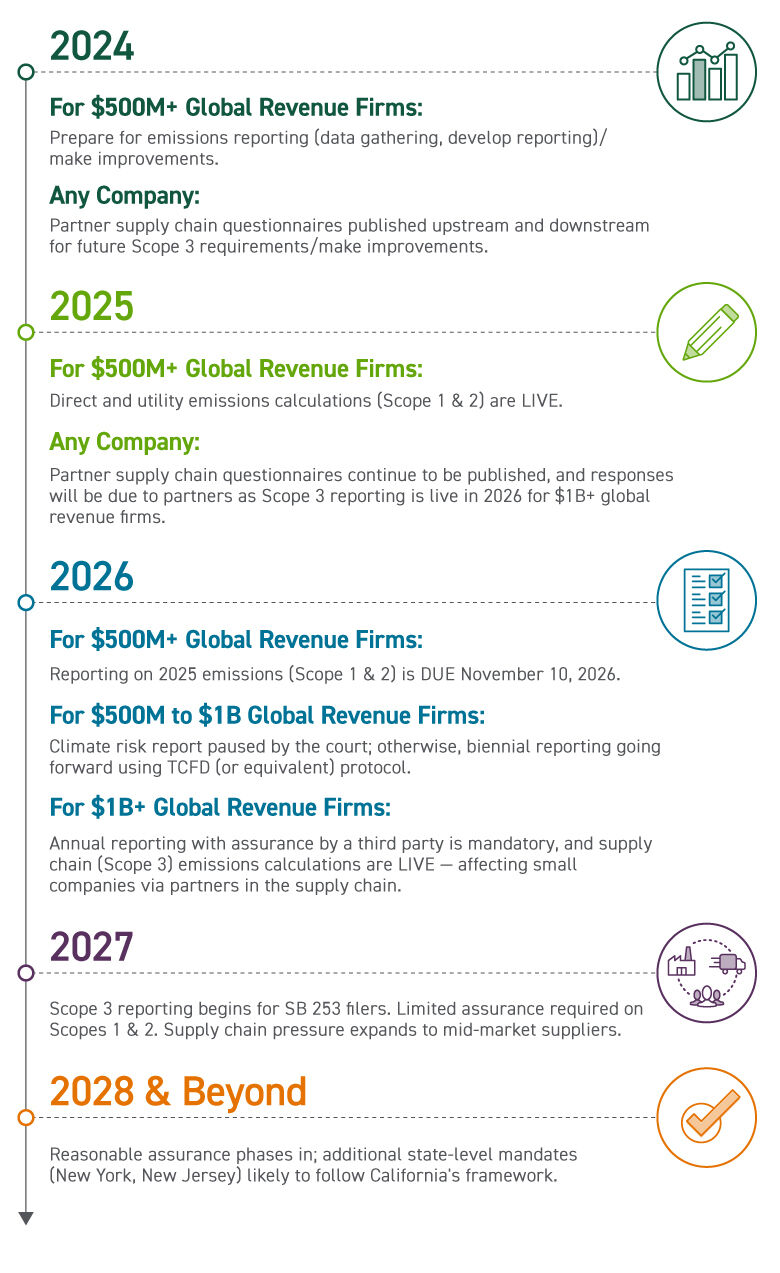
Many organizations view climate reporting as a sustainability initiative. Increasingly, however, it is becoming a finance, governance and operational issue. Building a repeatable process for collecting and validating emissions data today positions organizations not only for regulatory compliance, but also for customer requests, financing discussions and future assurance requirements.
Determine Your Scope: Quick Decision Tool for SB 253 and SB 261
Step 1: Are You Directly in Scope?
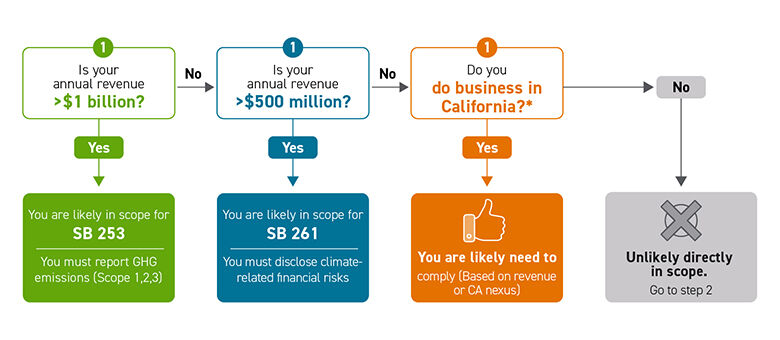
*Doing business in California includes sales, employees or operations in California — even if you are headquartered elsewhere.
For companies directly in scope:
- Build or refine GHG inventory (Scope 1 and 2, then Scope 3)
- Conduct climate-related financial risk assessment
- Prepare for 2026 reporting deadlines and beyond
Although SB 261 does not require organizations to publicly report greenhouse gas (GHG) emissions, many companies will find that developing a GHG inventory is a practical first step in conducting a meaningful climate-related financial risk assessment. Understanding an organization's emissions profile helps identify transition risks associated with evolving regulations, customer expectations, market shifts and decarbonization initiatives, while also providing important context for evaluating climate-related risks and opportunities.
As a result, many organizations subject only to SB 261 may benefit from establishing at least a foundational GHG inventory to support a more robust and defensible climate risk assessment.
Step 2: Not in Scope? You May Still Be Impacted
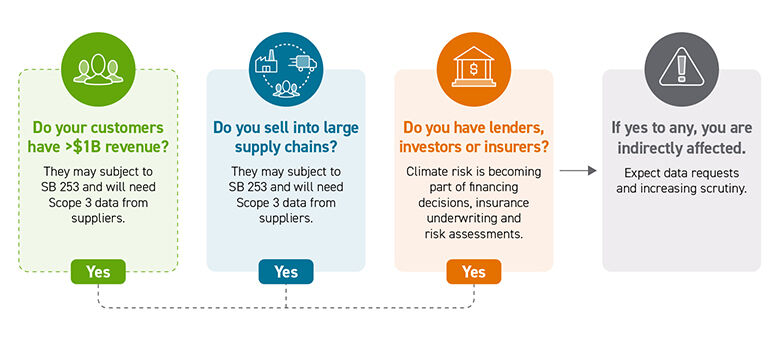
For indirectly affected mid-market companies, be able to answer at least two questions:
- What are your emissions?
- What are your biggest risks?
You can start with high-level GHG estimates and operating climate risks (three to five exposures).
Five Actions To Achieve Compliance
Obtaining accurate and comprehensive emissions data and, more importantly, the capability to analyze, disclose and transition that data, is the key to achieving compliance in this landscape now and into the future. All climate reporting is fundamentally data-driven, and this information is also critical for identifying climate-related financial risk, areas for improvement and establishing realistic future emission reduction targets.
With the understanding that your data strategy sits at the center of this journey, we break down the five key phases that emerge from there:
1. Assess Your Exposure
Identify which customers, lenders, and regulators are requesting emissions data, what frameworks they require, where SB 253 and SB 261 thresholds apply to your entity structure, and where climate-related financial risks may affect operations, strategy, supply chains or access to capital. A sustainability compliance assessment can assist in this process.
2. Establish a Scope 1 and 2 Baseline/Defensible Process
Use the GHG Protocol to measure direct and purchased-energy emissions, document methodology and lock in a defensible starting point for the August 2026 filing and Scope 3 categories. This can be achieved by automating data gathering to both understand your current benchmark and define future goals.
While SB 253 has received significant attention because of its emissions reporting requirements, organizations subject to SB 261 should not overlook the need to establish a defensible process for identifying, evaluating and disclosing climate-related financial risks. For many companies, this may require new collaboration between finance, risk management, operations and sustainability functions.
3. Prepare Your Data
Build the supporting evidence and understand your current emissions profile — utility bills, fuel records, fleet data, emissions factors — and document assumptions so the inventory is assurance-ready when limited assurance takes effect in 2027.
4. Be Ready To Respond and Develop Your Disclosure Approach
Whether responding to SB 253, SB 261 or stakeholder-driven requests, organizations should establish a repeatable process for communicating emissions data and climate-related risks. This includes preparing responses to Carbon Disclosure Project (CDP) questionnaires, supplier portal requests, requests for proposals (RFPs) and customer contract clauses, as well as documenting how climate risks are identified, assessed and managed.
5. Improve Over Time
As your climate reporting program matures, use your GHG inventory and climate risk assessment to identify operational efficiencies, prioritize emissions reduction initiatives, strengthen supply chain resilience and inform long-term business strategy.
Technology Investment To Meet the Current Challenge and Achieve Future Goals
Meeting the requirements of California’s carbon reporting rules at scale calls for investment in technology and innovation, and more specifically, in carbon accounting software, corporate emissions dashboards, data analytics tools, and an appropriate carbon calculator to streamline the data collection and analysis processes.
Automation capabilities from these technology investments additionally improve accuracy and reduce the administrative burden associated with ongoing compliance needs, especially as reporting obligations will not be a one-time effort but an ongoing commitment. Companies should expect to regularly assess their emissions data, recalibrate their reduction goals, and adapt their strategies in response to changing regulatory landscapes and emerging best practices.
We expect CARB to issue additional guidance, as Scope 3 takes effect in 2027 and as other states follow California's lead.
How Cherry Bekaert Can Help
California's first reporting deadline is here, and the window to build a defensible response is narrowing. Cherry Bekaert's CFO Advisory Services team integrates climate disclosure into the broader financial reporting and risk infrastructure your CFO already oversees, working alongside our industry professionals.
Industrial manufacturers and consumer goods suppliers with California operations face the most concentrated combination of direct SB 253 exposure, customer Scope 3 pressure and supply-chain complexity. Our Industrial Manufacturing practice, paired with a local presence in California, helps these companies move from assessment to filing without having to stand up parallel programs.
We help clients:
- Build right-sized, assurance-ready GHG inventories that are not overbuilt for the current regulatory state
- Respond to customer, lender and insurer data requests with consistent, defensible methodology
- Conduct climate-related financial risk assessments tied to actual financial impact
- Integrate climate data into enterprise risk management and financial reporting workflows
- Build scalable reporting processes that can adapt to evolving regulatory, customer and investor requirements
Related Insights
- Article: Carbon Accounting Frequently Asked Questions (FAQs)
- Article: Regionalization and Carbon Neutrality Strategies Positively Impact Manufacturers
- Case Study: Going Green: How a Manufacturer Can Drive Profits While Reducing Carbon Footprint
- Article: IRS Continues to Issue Guidance for Implementing Clean Energy Tax Credits
- Webinar: California’s Climate Disclosure Laws Are Coming: What it Means for Your Company and How it Can Be a Competitive Advantage
