


The Paradox of a Record Year
By almost any headline measure, the hedge fund industry is having its best run in a generation. According to the Hedge Fund Research (HFR) Global Hedge Fund Industry Report, global industry capital reached $5.6 trillion at the end of the second quarter of 2026, following a quarterly increase of $409.3 billion. That single-quarter gain is the largest quarterly increase on record, surpassing the previous record of $290.4 billion set in the fourth quarter of 2020. Net investor allocations across the trailing three quarters reached $134.4 billion, and well beyond the $115.8 billion recorded across all of 2025.
Beneath that headline sits a less comfortable statistic. The most recent HFR published data counted 129 fund liquidations in the first quarter of 2026, the highest quarterly total since the second quarter of 2024, even as launches climbed to 166 from 136 in the prior quarter. Both figures rose together, signaling that capital is concentrating within a shrinking share of funds.
This report examines that rising tension. Record aggregate growth is not reaching every fund, and the mechanism that sorts the winners of new capital from the strugglers has morphed from a performance mechanism into an operational one.
Key Takeaways
- A Strong Return Environment Has Made Performance Less Differentiating: Consecutive double-digit years and broad-based gains across strategy groups mean most credible managers are posting credible numbers. When performance no longer separates a peer group, allocators are selecting the operating model instead.
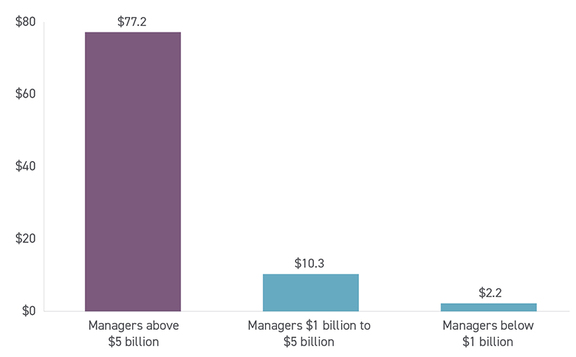
- Capital Concentration Is a Proxy for Operational Readiness, Not Brand Preference: Firms above $5 billion AUM captured $77.2 billion of net inflows in the first half of 2026, against $12.5 billion for those below that threshold. That places 86% of all first-half net inflows with the largest cohort. Mid-sized and emerging managers prioritizing operational structure are turning a cost constraint into a question of intention.
- Regulatory Readiness and Fundraising Readiness Have Converged Into the Same Body of Work: An accumulation of regulatory factors generates the same artifacts that operational due diligence examines. Managers who treat compliance as a cost center and fundraising as a separate initiative are paying twice for work that could be built once on a multi-quarter cycle that does not accommodate an open fundraising window.
A Macro Environment That Flatters Everyone
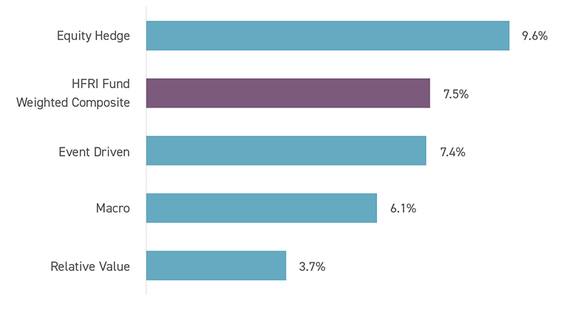
The industry entered 2026 on consecutive double-digit years. The Barclays 2026 Hedge Fund Outlook put the 2025 average at 11.2%, with positive contributions across every major strategy group. The first half of 2026 extended the turnaround. The HFRI Fund Weighted Composite Index gained 7.5%, its strongest first-half performance since 2021. Equity hedge strategies led the major groups at 9.6%, with technology-focused funds up 19%, supported by strength in artificial intelligence (AI)-linked names alongside an active calendar of initial public offerings and mergers and acquisitions. Event-driven strategies returned 7.4% and distressed managers 12.4%. Macro advanced 6.1%, and relative value returned 3.7%. Citco's administered fund universe recorded a weighted average return of 2.4% in June and net inflows of $70.4 billion across the first six months.
Every Major Strategy Group Gained in the First Half of 2026
Volatility has been the industry's ally. Escalation in the Iran conflict, oil price dislocation, uncertainty around AI-driven disruption to incumbent technology franchises and liquidity concerns in private credit have all reinforced the case for liquid, diversifying, lower-correlation exposure. Slowing distributions from private markets have added to the pull.
When a favorable macro backdrop lifts most of the field, strong returns become less differentiating. If a majority of managers in a peer group post credible numbers, performance stops functioning as a selection filter, and allocators select on something else.
July tested that proposition. Goldman Sachs stated in August that its Hedge Fund VIP list of the most popular long positions suffered its worst one-month underperformance against the S&P 500 in more than 20 years of history. July also marked one of the sharpest hedge fund de-grossing episodes of the past decade, as funds trimmed AI positions, including many semiconductors and most mega-cap names. Goldman noted that U.S. equity long-short funds were still up 10% through mid-August, so the year remains intact.
Operational Due Diligence Now Decides Allocations
The clearest evidence of the shift is structural. Investment due diligence and operational due diligence (ODD), once sequential stages in an allocation process, now run in parallel from first contact. Allocators now assess infrastructure, governance, risk management and organizational depth at the same moment as strategy and track record, not as a confirmatory step after an investment committee has formed a view. The arithmetic facing managers is unforgiving. The Barclays H2 2026 Hedge Fund Outlook, drawn from a survey of 340 investors representing $8.7 trillion in assets, found that allocators ultimately commit capital to roughly 5% of the managers they meet. Net allocation interest over the same period climbed to 43% from 37% a year earlier. Although demand is rising, the conversion rate is not. In our experience much of that attrition is caused by managers who clear the investment test and fail the operational one. That failure may look like an unclear valuation policy, a compliance program with visible gaps, thin coverage in the finance function, or a vital process that lives in one person's head.
The concentration data tells the same story from the allocator's side of the table. Firms managing more than $5 billion attracted an estimated $38.1 billion in net inflows during the second quarter, against $6.3 billion for managers in the $1 billion to $5 billion range and roughly $700 million for those below $1 billion. Across the first half, the split was $77.2 billion, $10.3 billion and $2.2 billion respectively. Citco's data points in the same direction, with funds above $10 billion in assets under administration capturing $54.4 billion of year-to-date flows through June.
Net Inflows Concentrated Above $5 Billion in Assets
It would be simple to attribute this concentration to pure brand preference. The concentration is less about brand preference than a proxy for operational readiness. Large managers are not winning because they are large; they are winning because scale has historically been the only affordable route to institutional-grade infrastructure. That link has broken, which opens an opportunity for mid-sized and emerging managers. Outsourced operating models, dedicated service providers and modern technology now allow a firm to build institutional-quality operations far earlier in its lifecycle than was possible even five years ago.
Infrastructure as the Real Differentiator
Several areas consistently determine capital raising success, including:
- Valuation and Independent Oversight: Documented valuation policies, consistently applied, with genuine independence between the investment team and the pricing process. This remains among the most common points of failure and the least defensible, as it is entirely within a manager's control.
- Fund Administration and Financial Reporting: Reconciliation discipline, net asset value timeliness, audit history and auditor quality, and the depth of the finance and accounting function relative to strategy complexity.
- Governance and Key-person Risk: Allocators are pressing on whether returns reflect a reproducible process or a single individual. Board composition, key-person provisions, succession planning and documented investment process all speak to this.
- Counterparty, Treasury and Liquidity Management: Prime broker diversification, cash and collateral controls, and the alignment between portfolio liquidity and redemption terms, an area that draws sharper questions in any period of credit stress.
- Diligence Response Capacity: An underrated operational discipline in its own right. Due diligence questionnaires (DDQs) have grown in scope and response windows have compressed. A manager without a maintained, current DDQ library and a named owner for the process can be eliminated before a meeting is ever scheduled.
The separately managed account (SMA) shows how these elements combine. Barclay’s H2 2026 survey found SMA adoption among hedge fund investors continuing to increase. SMAs require parallel reporting, bespoke guidelines, additional reconciliation and heavier technology, which is why they work as an operational screen. Managers who can support the structure gain access to the largest pools of capital. Managers who cannot are quietly excluded from conversations they never knew were happening.
Technology and AI: Scale Without Headcount
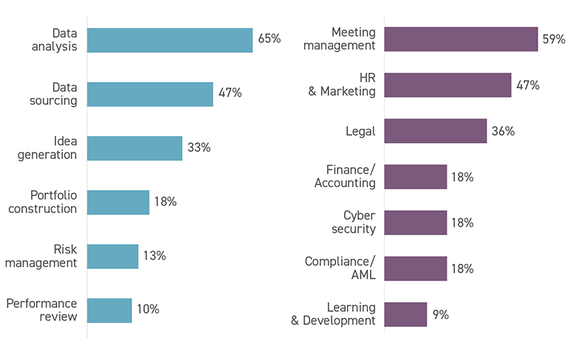
Technology enters this discussion on two fronts, investment process and operating model. Managers who conflate them tend to invest poorly in both. Here, adoption across the industry is broad, rather than experimental. The Barclays 2026 Hedge Fund Outlook found hedge funds applying AI across the business: 65% use it for data analysis and 47% for data sourcing, while 59% use it for meeting management and 47% for investor relations and marketing. These tools deliver leverage rather than automation, meaning firms use them to expand analytical capacity without a proportional increase in headcount, which changes the economics of competing against larger, better-resourced peers.
Where Hedge Funds Are Applying AI
The operating model is where the near-term return is more reliable. Workflow automation in reporting, reconciliation, investor communications, compliance monitoring and diligence response reduces the fixed cost of institutional-grade operations. For a mid-sized manager, this is the practical path to clearing an ODD bar that was previously accessible only through headcount. Managers that build proprietary systems in-house may also qualify for the federal research tax credit, and the value of that internally developed technology becomes a fair value question of its own.
However, two cautions belong here. First, allocators are deploying the same tools to evaluate managers. Screening that once relied on relationships and conference introductions is increasingly systematic, which means inconsistencies across a manager's materials, filings, and disclosures surface faster.
Second, AI governance is now itself a diligence subject. The Division of Examinations named emerging financial technology, including AI, as a fiscal 2026 risk area. Allocators and examiners alike are asking how models are validated, what data governs them, who is accountable for outputs and whether public claims about AI capability match internal reality. Firms that market sophistication they cannot document create disclosure problems rather than advantages.
“Allocators have changed how they evaluate hedge funds. Performance remains important, but it is no longer sufficient on its own. Today's investors are spending just as much time assessing a fund's operational structure, technology and AI use as they are reviewing returns.”
The Regulatory Calendar That Matters
Several near-term dates warrant attention from managers and their finance and compliance leadership:
Treasury Clearing: December 31, 2026 and June 30, 2027
The clearing mandate for U.S. Treasury securities applies to eligible cash market transactions from December 31, 2026, and eligible repurchase transactions from June 30, 2027. For any manager running a cash-and-futures basis strategy or financing through repo, this is the most consequential structural change on the calendar. It reaches margin, counterparty documentation, collateral operations and treasury workflow at once. It is important to confirm clearing access and documentation ahead of the cash market date.
Form PF: July 1, 2027
On August 31, 2026, the Securities and Exchange Commission (SEC) and the Commodity Futures Trading Commission (CFTC) adopted a joint final rule moving the compliance date for the February 2024 Form PF amendments from October 1, 2026, to July 1, 2027. The nine-month extension is the fourth granted on a date originally set for March 2025.
The commissions tied this extension to their own pending rulemaking. Their April 20, 2026 proposal would raise the all-filers threshold from $150 million to $1 billion in private fund assets and the large hedge fund adviser threshold from $1.5 billion to $10 billion. The commissions estimate it would end the filing obligation for nearly half of current filers while still capturing roughly 90% of private fund gross assets. Comments closed June 23, 2026, and remain under review, so the delay spares filers the cost of building to requirements that may be amended or withdrawn.
The commissions were also explicit that the new date gives filers time to comply with the 2024 amendments if the proposal is not adopted in whole or in part. Managers should, therefore, build the reporting capability on the original timeline. Form PF demands the same data assembly allocators request in diligence, and that request does not move when a filing deadline does. July 1, 2027, also falls one day after the June 30, 2027, Treasury repo clearing deadline, which leaves a single compressed quarter for managers running both projects.
FASB ASU 2026-03 Fair Value of Equity: December 15, 2027
The Financial Accounting Standards Board (FASB) issued ASU 2026-03 on September 9, 2026, requiring investment companies to discount the fair value of equity securities subject to a contractual sale restriction, such as a post-IPO lock-up, rather than valuing them as if unrestricted. The recent change also requires investment companies to disclose the amount of the discount attributable to contractual sale restrictions.
ASU 2026-03 reaches event-driven, activist, and credit funds holding lock-up positions or equity co-investments alongside debt, including business development companies, though it leaves macro, relative value and market-neutral strategies largely untouched. Because net asset value drives subscription and redemption pricing, an overstated restricted position lets a redeeming investor take more than that investor's economic share. The change is effective becomes effective December 15, 2027 but early adoption is permitted now.
AML Program Requirements: January 1, 2028
The Financial Crimes Enforcement Network (FinCEN) moved this rule to January 1, 2028, by final rule issued December 31, 2025. The rule extends the anti-money laundering (AML) program, suspicious activity reporting and recordkeeping obligations to registered investment advisers and exempt reporting advisers. FinCEN intends to revisit the scope first, and a related customer identification program proposal remains pending. The runway argues for building deliberately rather than deferring: allocator diligence on AML controls is not waiting for the effective date.
Recent requirements already in effect include:
Regulation S-P: June 3, 2026
Advisers below $1.5 billion in assets under management reached their compliance date on June 3, following the December 3, 2025, deadline for larger firms. Written incident response programs, service provider oversight and investor notification procedures should be in place and documented. The Regulation S-P amendments matter more to private fund managers than the headline suggests. By shifting the standard from customer records to customer information, they capture advisers that manage only private funds, which had previously fallen outside the rule for want of natural-person customers.
Fiscal 2026 Examination Priorities
The Division of Examinations released its fiscal 2026 priorities on November 17, 2025, the first under Chairman Paul Atkins. Private fund advisers no longer appear as a standalone category, marking the first time in at least six years that the division has not carved them out. This should not be read as reduced scrutiny. Private fund considerations are distributed across multiple thematic areas, including fiduciary duty, valuation and liquidity, fees and expenses, conflicts of interest, custody, operational resiliency and emerging technology governance. Advisers to newly launched funds and managers new to private funds receive specific mention, as do funds holding illiquid assets such as private credit. The Division of Examinations is expected to publish fiscal 2027 priorities by December 2026.
Every regulatory item above generates documentation. That documentation is exactly what ODD examines. Compliance preparation and fundraising preparation now draw on one body of work.

Tax Considerations Allocators Actually Notice
Tax structuring is often treated as a back-office concern. In an institutional fundraising context, it is a visible signal of operational maturity.
Investor reporting timeliness is the most direct example. Late or repeatedly amended Schedule K-1s are read by allocators as evidence of weakness in the finance function, independent of the underlying tax position. Institutional investors with their own reporting obligations track this closely.
Structuring for a diversified investor base means accommodating tax-exempt investors, non-U.S. capital and taxable domestic investors within a single platform. That requires deliberate entity design, and it becomes expensive to retrofit once capital is committed. State and local exposure deserves parallel attention as managers add offices, personnel, and remote arrangements, along with pass-through entity elections and the resulting investor-level consequences.
Carried interest treatment, incentive allocation mechanics, and the interaction between fund-level structuring and management company planning round out the areas most likely to surface in diligence.
What Separates the Two Groups
The hedge fund industry is not bifurcating between good performers and bad ones. Performance across the first half of 2026 was broadly strong, and July demonstrated how quickly that can change when a crowded theme turns. Instead, the bifurcation is between managers who can demonstrate institutional durability and managers who cannot.
That distinction has a timing problem, as operational infrastructure is built on a multi-quarter cycle: systems selected and implemented, policies drafted and tested, service providers onboarded, audit history accumulated, documentation maintained. Fundraising windows do not wait for that cycle to complete. By the time a manager discovers that an ODD gap cost them an allocation, the remedy is a year of work, and the mandate has been placed elsewhere.
The managers capturing capital in this cycle made those investments before they needed them. Firms of any size can utilize that lesson in readiness to their advantage – the work takes a year, and the window won’t wait.
Guiding Hedge Fund Managers to Operational Readiness
Cherry Bekaert's Asset Management Hedge Funds practice works with fund managers across the operating model, from fund audit and valuation policy through tax structuring, investor reporting and regulatory readiness. To discuss how these developments affect your fund operations, contact our hedge fund team.