


Artificial intelligence (AI) adoption is becoming a key differentiator between insurers. As one survey respondent noted in Cherry Bekaert's inaugural CFO survey, “Widespread adoption of AI and automation is set to reshape everything from underwriting to financial reporting,” highlighting the industry’s ongoing transformation.
It’s clear that the opportunity is significant. According to McKinsey, generative AI (GenAI) could unlock up to $70 billion in additional annual revenue for the insurance industry. Meanwhile, Capgemini shows that 92% of insurers believe AI agents will enable expansion into new geographies without requiring significant upfront infrastructure investments.
$70B
unlocked in additional revenue due to GenAI
92%
of insurers believe AI agent will enable expansion
As data volumes increase and customer expectations evolve, insurers face growing pressure to modernize. Those that delay AI adoption risk falling behind competitors that are using AI-driven models to transform pricing, service delivery and risk evaluation.
Key Takeaways
- AI is reshaping insurance operations and creating significant growth opportunities.
- Insurers use AI to improve underwriting, claims, fraud detection, risk management, customer service and code modernization.
- AI can increase speed, accuracy, scalability and cost efficiency, but introduces data, bias, integration and compliance risks.
- Strong governance, quality data and human oversight are essential for sustainable AI adoption.
What Does Artificial Intelligence Look Like in Insurance?
Artificial intelligence in insurance refers to the use of technologies that can analyze information, identify patterns, generate content and support decision-making across core insurance functions, such as underwriting, claims management, fraud detection and customer engagement, among others. This shift enables insurers to move toward more dynamic and responsive operating models, where processes improve over time with experience and data inputs, providing useful, proactive information with which to make decisions.
For years, the insurance industry depended on human underwriters and claims adjusters to manually review complex policy documents, medical records and inspection reports and to analyze large amounts of data to make decisions. Today, AI systems support these professionals by quickly highlighting key insights, visualizing trends and unique patterns in data and helping management teams spend more time on complex and high-value decisions.
Machine Learning (ML)
ML analyzes historical data for tasks like risk assessment, pricing policies and detecting fraudulent claims, allowing insurers to make more informed decisions.
Natural Language Processing (NLP)
NLP extracts insights from unstructured data such as policy documents, emails and customer conversations. It also powers chatbots and virtual assistants for customer support.
Robotic Process Automation (RPA)
RPA handles routine tasks like data entry, policy administration and claims processing, streamlining back-office operations by reducing manual intervention.
Generative AI (GenAI)
GenAI drafts reports, summarizes documents and generates customer communications. It also assists teams in creating personalized content at scale.
Computer Vision
Computer vision assesses damage from images and videos, especially in auto and property claims, accelerating inspections and improving claim evaluations.
Application Programming Interfaces (APIs)
APIs connect AI solutions with policy administration systems, claims platforms and third-party platforms, enabling real-time information exchange and streamlined workflows.
Predictive Analytics
Predictive analytics forecasts claim likelihood, customer behavior and risk exposure. It supports decision-making in underwriting, pricing and customer retention strategies.
Understanding the Benefits and Risks of AI Adoption in Insurance
Insurers are increasingly adopting AI to improve underwriting accuracy, streamline claims processing, enhance customer experiences and reduce operational costs. However, unsuccessful implementation requires addressing challenges related to data quality, regulatory compliance, governance and workforce readiness.
Benefits
Understanding the benefits of AI helps insurers identify where it can create real value, guiding smarter investment and adoption decisions. The benefits of utilizing AI in insurance include:
- Speed and Efficiency: Reduces processing time across operations
- Improved Accuracy: Minimizes errors in data handling and evaluations
- Stronger Fraud Prevention: Detects unusual patterns more effectively
- Cost Optimization: Lowers operational overhead through automation
- Scalable Operations: Supports growth without proportional resource increases
- Consistent Decision-making: Ensures standardized outcomes across processes
Risks
The use of AI in the insurance industry also introduces certain risks that organizations must carefully consider. Key risks include:
- Data Privacy Concerns: Increased reliance on sensitive data raises security risks
- Algorithmic Bias: Models may reflect biases present in training data
- Integration Challenges: Aligning AI with legacy systems can be complex
- Regulatory Uncertainty: Evolving compliance requirements create additional pressure
- Lack of Explainability: Some AI outputs are difficult to interpret and audit
- Model Drift: Performance can decline over time if models are not continuously monitored and updated
As AI adoption expands, insurers must establish governance frameworks that address model risk, transparency, regulatory requirements and responsible AI practices. Strong governance helps organizations maintain trust while ensuring AI-driven decisions remain fair, explainable and auditable.

6 Common Use Cases of AI in Insurance Companies
Exploring these use cases provides a clearer view of how AI is being applied in practice across different areas of the insurance value chain. The use cases include:
- Claims Management
- AI-powered Underwriting
- Fraud Detection
- Risk Management
- Customer Service
- Code Modernization
1. Claims Management
AI accelerates how claims are reviewed, validated and resolved, which directly impacts customer satisfaction and operational costs. By reducing manual intervention and enabling faster decision-making, AI helps insurers deliver quicker settlements and more consistent outcomes. It is especially valuable during high-claim volumes, such as natural disasters or peak periods.
Claims teams, adjusters and operations leaders benefit the most from these capabilities.
2. AI-powered Underwriting
AI brings greater consistency and depth to risk evaluation processes, directly affecting profitability and risk exposure. By incorporating multiple data sources and reducing reliance on manual judgment, AI enables more precise and scalable decision-making. It is best used when insurers are handling large volumes of applications or expanding into new markets.
Underwriters, risk analysts, and product teams can leverage AI to improve efficiency and decision quality.
3. Fraud Detection
AI continuously monitors patterns and identifies unusual behaviors that may go unnoticed manually. This is crucial because fraud can lead to significant financial losses and reputational damage. By enabling early detection and real-time alerts, AI helps insurers take proactive action and minimize risks. It is most effective in environments with high transaction volumes and complex claim scenarios.
Fraud investigators, compliance teams and claims departments benefit greatly from these insights.
4. Risk Management
AI provides deeper visibility into potential threats and emerging trends, helping insurers maintain financial stability and meet regulatory requirements. By analyzing both internal and external data, AI helps insurers anticipate risks and make proactive adjustments to their strategies. It is particularly useful during periods of market uncertainty or when entering new risk segments.
Risk managers, executives and strategic planners can use these insights to make more informed decisions.
5. Customer Service
AI transforms customer service by enabling faster, more consistent and scalable interactions, which is especially important as customer expectations continue to rise. By automating routine queries and supporting agents with relevant information, AI improves both efficiency and customer experience. It is best applied in high-volume customer interaction scenarios, such as policy inquiries or claims updates.
Customer support teams and service managers are the primary beneficiaries.
6. Code Modernization
AI-driven code modernization helps insurers transition from legacy systems to more agile and scalable technology environments, accelerating innovation and decreasing maintenance costs. By automating code analysis, refactoring and documentation, AI accelerates modernization efforts and reduces technical debt. It is most valuable when organizations are undergoing digital transformation or integrating new technologies.
IT teams, developers and digital transformation leaders can take full advantage of these capabilities.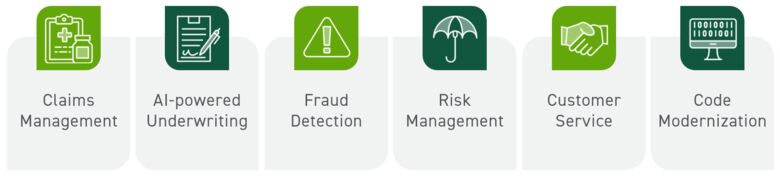
Next Steps on Insurance and AI
Technologies such as generative AI, Internet of Things (IoT), and even drones are enabling insurers to anticipate risks, automate underwriting and process claims in near real time. As these capabilities mature, AI is expected to become nearly universal across insurance operations, fundamentally reshaping how policies are designed, priced and delivered.
This transformation is giving rise to a hybrid workforce, where human expertise is augmented by AI-driven insights and decision support. Rather than replacing human roles, AI in insurance is enhancing them, allowing teams to focus on complex judgment, customer relationships and strategic decisions. As a result, the future of insurance will be defined by closer collaboration between humans and intelligent systems.
AI in Insurance: Frequently Asked Questions
The most common types of AI used in the insurance industry include:
- Machine Learning
- Natural Language Processing
- Robotic Process Automation
- Generative AI
- Computer Vision
- Application Programming Interfaces
- Predictive Analytics
AI adoption introduces several challenges that insurers must address. Increased reliance on sensitive data heightens privacy and security risks, while algorithmic bias can lead to unintended outcomes if models reflect flaws in training data. Many organizations face integration challenges when connecting AI solutions to legacy systems, and evolving regulations add further compliance complexity.
Overall, AI boosts efficiency and decision-making, enabling faster, more precise claim resolution. AI claims management can streamline workflows, fraud identification and loss evaluations. It reduces turnaround times, strengthens data capture, and enhances customer support through chatbots and predictive insights.
Your Guide Forward
A critical aspect of successful AI adoption is building the right organizational and governance framework. Insurers must ensure data quality, establish clear accountability for AI-driven decisions, and address concerns related to transparency, fairness and compliance. This often involves developing internal guidelines, investing in talent, and creating processes to monitor and refine models over time.
Cherry Bekaert’s Insurance practice professionals can support this journey by helping insurers address adoption challenges, align AI initiatives with business goals, and implement solutions that deliver measurable outcomes. With the right guidance, organizations can move beyond pilots and turn AI into a sustainable competitive advantage.