


Operating as the Finance Architect, chief financial officers (CFOs) are racing to design a modern finance function capable of realizing the value of artificial intelligence (AI). Some are already there, with automated workflows, integrated systems and AI woven into daily operations. Many others still rely on spreadsheets and disconnected systems to bridge gaps between operations and finance.
The gap between intent and impact is rarely about ambition or budget, but rather a result of technology paralysis and uncertainty about where to start — the foundation. Before AI, dashboards or predictive analytics can move the needle, finance leaders need a working digital core.
The term “digital core” itself gets used loosely. It shows up in vendor pitches, board decks and strategy documents, often as a stand-in for "our technology," and treating it that way is one major reason finance transformation efforts stall.
What Is the Digital Core?
While other organizations have coined their own definitions, a digital core is often used to describe an enterprise-wide technology stack. Cherry Bekaert defines the digital core more specifically as the connected foundation that enables any organization to operate on a single, current and reliable view of itself. It sits at the center of the finance function, and it determines whether reporting, analytics and AI produce trustworthy output.
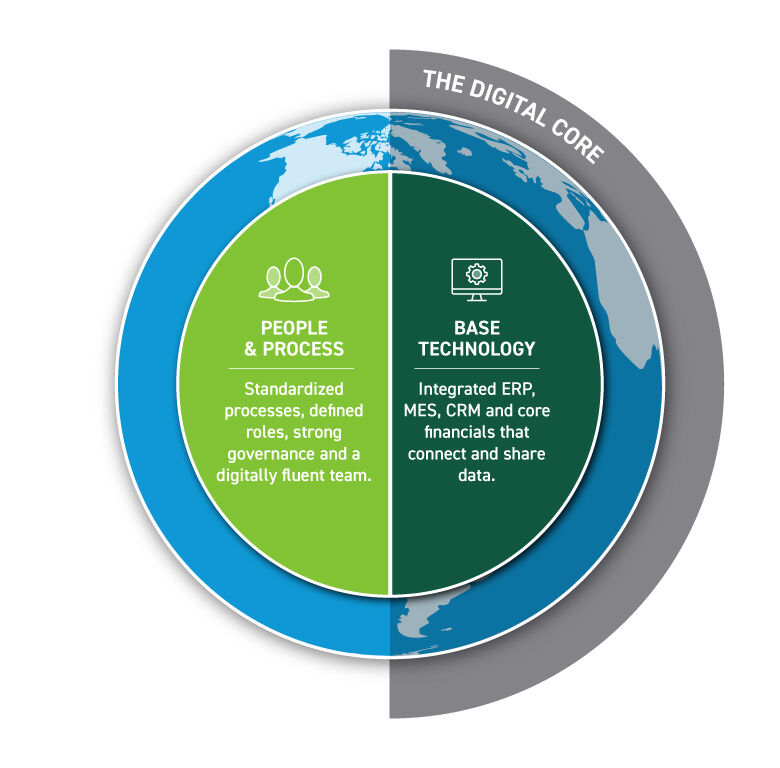
Two components make up the core: (1) people and process and (2) base technology.
1. People and Process
People and process refer to standardized workflows that are automated where possible, a workforce that understands the systems in front of them, and defined roles that keep the process running consistently. This layer often gets overlooked because leaders do not associate people and process with "digital", but without them, no technology investment holds.
2. Base Technology
Are the right systems talking to one another? This often means an AI-ready enterprise resource planning (ERP) system integrated with outside sources, a customer relationship manager (CRM) connected to core financials, and the underlying platforms that tie the manufacturing execution system (MES), production, financial management and reporting together.
Together, People and Process Plus Base Technology Form the Digital Core.
When both components are working properly, finance can answer a question once and trust the answer. When either is missing, the same question produces different numbers depending on which system generated the report.
What the Digital Core Is Not
The digital core is not reporting and analytics. It is not a flashy dashboard project, a data lake or an AI initiative. Those capabilities are what the core makes possible, not the core itself.
This distinction matters because most middle-market organizations often invest in the visible layer first. They buy a new BI tool or pilot an AI use case, only to discover that the outputs cannot be trusted because the systems feeding them are disconnected and the underlying processes are inconsistent. AI is not a shortcut around a weak digital core. It is a multiplier of whatever sits beneath it.
Why the Digital Core Matters Now
Every industry can benefit from a strong digital core, but its importance is especially evident in industrial manufacturing. Manufacturers rely on data flowing seamlessly across finance, operations, procurement, inventory, production and the supply chain. As organizations grow, these functions often become spread across multiple systems that were not designed to work together. Without an integrated foundation, leaders struggle to gain a clear view of costs, margins and operational performance.
Our industrial manufacturing Middle-Market CFO Survey snapshot reinforces the need for a strong digital core. Manufacturing CFOs identified data and system challenges as some of their most significant barriers to performance, with 100% citing a lack of data for critical decision-making and 91% reporting issues with their financial systems. In an environment where finance leaders are increasingly involved in operational decisions, disconnected systems do not just slow the business down. They limit visibility into costs, margins and the operational drivers that influence profitability.
The challenge is not simply implementing new technology. Manufacturing finance leaders identified several obstacles that hinder modernization, including legacy systems, inconsistent plant data and critical talent gaps. In fact, 91% reported finance talent shortages, and half cited broader skills gaps related to system literacy and data fluency. As manufacturers look to modernize, success depends on building the internal capabilities needed to connect data, streamline processes and turn information into faster, more confident decisions.

How To Develop the Digital Core
Building the digital core is a sequenced set of foundational decisions that make later investments possible. Some practical steps are to:
- Start With Process, Not Software: Standardize the workflows the business already runs before selecting new technology. An ERP layered on top of manual workarounds inherits every one of them.
- Define the Source of Truth. For each critical metric — capacity, inventory turns, margin performance, days sales outstanding (DSO), and forecast accuracy — name the system that owns it and the rules that govern how it flows to the others.
- Integrate the Base Stack: ERP, operational systems, CRM and core financial systems should exchange data through defined connections, not spreadsheets and manual reconciliation.
- Cleanse and Govern the Data: Identify the data that matters, establish governance and clean it before it feeds any downstream reporting.
- Invest in the People Who Will Operate It: Underinvestment in skills is where modernization most often stalls, even when the technology performs.
What This Looks Like for Industrial Manufacturers
Finance and Operations Alignment
For manufacturers, the most impactful starting point is often connecting finance, operations and supply chain data. Manufacturing CFOs reported greater involvement in operational decisions than their peers in other industries, making access to timely, reliable information critical. When production, inventory, procurement and financial data reside in disconnected systems, leaders struggle to make confident decisions about pricing, capacity and margins. Implementing improvements in focused 30/60/90-day sprints can demonstrate measurable progress while building momentum for broader modernization initiatives.
Cost, Margin and Working Capital Management
A second entry point is improving visibility into the drivers of profitability. Manufacturing CFOs identified managing costs and improving margins as a top priority, while also citing a lack of data for critical decision-making and financial system issues as significant barriers. By leveraging automation and AI to improve forecasting, inventory management, accounts receivable and accounts payable processes, organizations can strengthen cash flow, reduce manual effort and gain faster insight into operational performance.
ERP and Data Modernization
As manufacturers invest in growth initiatives, automation and ERP upgrades, a strong digital core becomes increasingly important. Standardized processes, trusted data and integrated systems help organizations scale efficiently and reduce the complexity created by disconnected applications. Establishing this foundation before pursuing larger transformation initiatives enables future investments in automation and AI to deliver greater value.
What Comes After the Digital Core
Once the core is in place, the finance function can move into what the base technology was always meant to enable: reporting and analytics powered by data governance, dashboards, advanced analytics and AI.
The AI-ready finance function rests on three pillars: a modern digital core, trusted data and a digitally fluent organization. Trusted data means one source of truth. Too often, teams run different reports out of different systems and get entirely different answers. Closing that gap is what makes AI outputs usable.
A fluent organization means leadership that understands why modernization matters and is willing to invest both time and dollars in it. Not long ago, a modern finance function was described as a competitive advantage. Today, standing still is a competitive disadvantage.
When deciding where to apply AI inside the core, work through a four-part lens:
- People: Right skill sets, trained on the AI already built into modern platforms
- Process: Standardized and automated where the human-in-the-loop can be removed
- Data: A governance structure that lets AI pull the right data at the right time
- Technology: AI connectors that link ERP, CRM, MES and financial systems into one connected environment.
The Bottom Line
The digital core is the difference between a finance function that reports on the past and one that guides the future. It is not analytics, and it is not AI. The digital core encompasses the people, processes and integrated technology that make analytics and AI worth investing in.
Let Us Be Your Guide Forward
Are you delaying the modernization of the finance function? Cherry Bekaert’s CFO Advisory professionals offer a complimentary Finance Modernization Assessment — a focused, structured conversation that identifies which operational or finance process to tackle first, what technology gaps exist and where AI can deliver value fastest.
Related Insights