In Cherry Bekaert's 2025 Middle Market CFO Survey, nearly two-thirds of finance leaders described their day-to-day work as broadly strategic rather than narrowly financial, with 52% reporting direct involvement in company-wide digital transformation, and 46% helping shape the business or operating model.
The role of the chief financial officer (CFO) has expanded well beyond traditional financial stewardship, a fact well documented by now. What is newer and far more consequential is what that expansion, enhanced by artificial intelligence (AI), has done to the software and systems that support the role.
For technology companies, that evolution is occurring alongside rapid innovation cycles, shifting business models and rising stakeholder expectations for fast, trustworthy insight to maintain financial integrity and support long-term growth.
The Finance Stack Has Become Strategic Territory
The finance stack has moved from a back-office function to one of the most strategically contested layers of the organization. As finance leaders take on broader responsibilities across planning, capital allocation, procurement, risk and operational decision-making, the systems they rely on have become more valuable, more complex and far more scrutinized by the C-suite, the board and outside investors.
Three expectations now sit squarely with the CFO:
- Decision authority over the enterprise technology stack
- Structural control of data governance and architecture
- Insight delivery that moves the organization from explaining what happened to anticipating what will happen next
That role looks less like a financial steward and more like a finance architect. The job is no longer to manage individual processes or systems, but to design how finance, sales operations and technology work together around a single trusted source of data.
Layer on the acceleration of AI, and the bar moves again. AI only performs as advertised when the data underneath it is governed, connected and trusted. That is precisely where most finance functions are weakest, and precisely why the CFO has to step into a different kind of role.
Technology CFO Expectations Are Higher
Technology CFOs are among the most operationally embedded finance leaders in the middle market, reporting significant involvement in strategic decisions, operations, and technology and data strategy, with 53% expecting to shape business model evolution in the coming year. As companies move from pure product firms to service-based and subscription-driven models, technology and data strategy have become core finance responsibilities. That expanded remit raises the bar on a modernization finance function.
The 3 Core Capabilities of the Finance Architect
A finance architect is a CFO who takes responsibility for designing and connecting the core elements of the finance function — people, processes, data and technology — into a cohesive structure that supports accurate data, scalable operations and timely, decision-ready insight.
These capabilities function as a system, and a gap in any one of them shows up in the other two.
Modern CFO as a Finance Architect
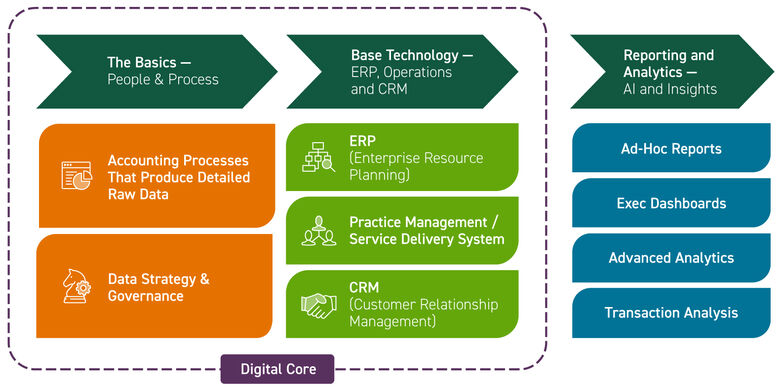
1. The Basics: People and Process
Every modern finance function rests on clearly defined processes and a deliberate operating model. That includes standardized accounting and reporting workflows, explicit ownership of every metric and handoff, and governance that upholds the standard when people change roles or systems change vendors.
Two diagnostic questions tend to surface the truth quickly:
- Are core workflows standardized and documented, or do revenue recognition, billing, monthly close and forecasting still rely on spreadsheets, tribal knowledge and manual reconciliation?
- Do the people in finance understand the systems well enough to actually use the AI and analytics tools the organization has already paid for?
When the answer to either question is no, layering new technology on top will not likely solve the problem, just accelerate it.
In Technology, Modern Tools Are Not the Same as a Modern Process
Unsurprisingly, technology CFOs lead all industries in adoption of cloud ERP, AI and machine learning (ML) finance tools, outpacing the all-industry averages. Yet spreadsheet reliance sits extremely high within these same finance functions. The tools themselves have been modernized, but the workflows around them have not. That gap is where return on investment (ROI) quietly leaks — in reconciliations between billing and revenue, in forecasts rebuilt by hand each cycle, and in the lag between insight and action.
2. Base Technology: ERP, Operations and CRM
Once the foundation (people and processes) is in place, the CFO has to take ownership of the technology landscape that sits on top of it: the enterprise resource planning (ERP) system, billing and revenue recognition platforms, professional services automation or delivery systems, and the customer relationship management (CRM) tool that captures pipeline activity, contract terms and renewal behavior.
The relevant questions here are not glamorous, but they are decisive:
- Is the ERP fully integrated with billing and revenue recognition, or are contract modifications, usage data and deferred revenue still being reconciled manually?
- Is the CRM connected to financial and operational systems so that pipeline, bookings and delivery capacity translate cleanly into revenue forecasts and cash planning?
Most middle-market finance functions have grown by addition rather than design. New tools have been layered in for accounting, treasury, spend, billing, tax and reporting as needs surfaced, and the resulting environment is rarely as coherent as the individual investments suggested. Standalone platforms can be strong performers in isolation and still leave the organization with an integration burden that consumes the close, distorts reporting and quietly absorbs a meaningful share of the team's capacity each month.
Resolving that condition is less about adding another software or technology platform and more about how the existing ones are wired together. That alignment is an architectural outcome.
The Digital Core: Where Transformation Actually Starts
People, processes and base technology come together to form what can be described as the finance function's digital core. People and processes define how work is performed. Core systems enable and scale that work. Together they produce reliable, governed data that everything else depends on.
The digital core is the prerequisite for advanced reporting, analytics, automation and AI. Without it, organizations stall at fragmented reporting or one-off improvements. Most finance transformation efforts that fail did not fail because the vision was unclear but because this foundational layer was never finished, and investment moved on before it was. For tech companies, the digital core is also what makes compliance defensible: accurate billing, revenue recognition and tax reporting depend on governed, connected workflows rather than spreadsheet workarounds that are difficult to audit.
3. Reporting and Analytics: AI and Insights
The final capability is the one the C-suite tends to ask about first: timely, decision-ready insight. In practice, that requires three things working together:
- Consistent reporting frameworks and published data governance.
- Near-real-time access to the metrics that actually drive the business, from net revenue retention and customer-level margin to days to close, cash predictability and forecast accuracy.
- Disciplined use of analytics and AI to shift from historical reporting to forward-looking guidance.
Finance leaders are no longer expected to answer only what happened. They are expected to explain what is likely to happen next, why it is likely to happen and what the business should do about it.
This is also where AI is most often misunderstood. AI is not a shortcut around a weak digital core. It is a multiplier of whatever sits beneath it. Built on clean, connected, governed data, it scales insight. In technology environments, AI can help sharpen pipeline-weighted forecasting, flag margin erosion at the customer level, surface billing and usage anomalies before they reach the close, and reduce the manual effort behind compliance evidence. However, each of these use cases depends on accurate, connected data.

Why Most Finance Transformation Efforts Stall
For middle-market organizations, building the right architecture can be an overwhelming barrage of strategic and operational questions converging.
The common result is technology paralysis: leaders defer the decision rather than risk the wrong one, and the cost of standing still compounds quietly.
The day-to-day evidence is hard to argue with. Our team at Cherry Bekaert still sees finance teams consistently spending the majority of their hours on exporting, formatting and reconciling data across systems rather than producing insights. Years of automation spending have not changed the underlying picture for most teams. The bottleneck has moved from manual entry to manual integration, and the workday still ends with someone stitching the numbers together.
Where modernization stalls, a familiar pattern shows up:
- No clearly defined architecture connecting processes, systems and data, leaving the digital core unfinished
- Overemphasis on selecting or implementing new technology before the foundational gaps are addressed
- Difficulty aligning stakeholders across finance, operations and IT, particularly around who owns each metric and who arbitrates when definitions conflict
- Underinvestment in the people who will operate the modernized function, which limits adoption even when the technology performs
There was a time when modernizing the finance function was treated as a competitive advantage. That window has closed. Standing still has become the real disadvantage, and it shows up where it hurts most: unreliable forecasts ahead of a raise or a board cycle, margin that cannot be traced to a customer or product line, compliance evidence assembled by hand, and a finance function that cannot keep pace as the business scales or absorbs an acquisition.
How CFOs Can Start Acting Like Architects
Moving forward requires a shift away from a project-based, tool-first mindset toward an architectural sequencing mindset. At Cherry Bekaert, we frame the modern finance function around four gears: people, process, data and technology. Each gear carries its own expertise, and progress in one without alignment of the others tends to seize the system.
Acting as the “Finance Architect,” it may initially make sense to start with the technology; however, a practical starting point looks less like selecting a tool and more like a sequence of architectural decisions:
- Assess current processes, systems and data flows to identify the disconnects and the manual workarounds that mask them
- Prioritize foundational improvements before introducing new tools, beginning with the highest-value operational and financial processes, such as quote-to-cash, revenue recognition or the forecasting model itself
- Define how core systems should integrate to support end-to-end workflows, with explicit owners, refresh cadences and quality thresholds for each key metric
- Establish governance around data ownership, reporting standards and system usage, then publish the rules so debates over which version of the number is right come off the table
- Treat decision velocity as a published key performance indicator (KPI) and fund the initiatives that shorten it quarter over quarter
Each step is designed to compound. Meaning, the close process gets faster because the data is cleaner, forecasts get sharper because the close is faster, and cash planning, contract terms and pricing, and investment decisions get bolder because the forecasts can be trusted.
Let's Help You Build a Modern Finance Function
The CFO role will continue to evolve as organizations place greater weight on data-driven decision-making, operational visibility, compliance readiness and technology-enabled growth. The CFOs who lead that evolution will be the ones who stop treating finance modernization as a sequence of projects and start treating it as an architecture they own.
Cherry Bekaert's CFO Advisory Services team works with organizations to assess the current state, identify the gaps that matter most and develop a practical roadmap aligned to business objectives. Contact our team to learn how you can build a more connected, insight-driven finance function, starting with a 60-minute, complimentary Finance Modernization Assessment.
Related Insights
- Article: Building the Digital Core in the Technology Industry
- Article: Technology Paralysis: Why Finance Modernization Stalls in the Technology Industry
- Report: What Middle Market Technology Industry CFOs Are Prioritizing in 2026
- Article: Building Scalable AI To Meet Growing Workforce Demands
- Article: What One Finance Leader’s Career Reveals About Staying Relevant in a Changing Profession
- Article: The Value of Outsourced Accounting for Tech Companies At Every Stage of Growth
- Report: U.S. Private Equity at Mid-year 2026: Activity Held, Value Collapsed